The Beauty and the Bat

This week, I read The Beauty and the Bat by Diane Williams, a beautiful short story about a woman’s one interaction with the “Lady with Cake.” The author does not give her a name or give context in the interaction that she has with this woman. Her friend Rae and Rae’s daughter, Maud, are also in the scene. Diane’s son makes a brief appearance in the scene and very short interaction with the “Lady with Cake.” From the network graph I made with Google Fusion Tables of the interactions (who spoke to who in the scene), it shows that the Lady with Cake is at the center of the “action” and speaks to most of the characters that were introduced in the story.

2016-11-14

Every character, Diane, Rae, Maud and Diane’s son, interacts and speaks to Lady with Cake (as shown below: the orange lines indicate the outward direction of the interaction i.e. The Lady with Cake speaks to all characters).

2016-11-14-1

The arrows show the direction and number of interactions with the other characters in the story. In this case, Rae, Diane and Lady with Cake have the most interactions. Diane speaking to Lady with Cake directly the most, which makes sense since Diane is the narrator of the story and describes her interactions with this mysterious and not so nice woman.

2016-11-14-42016-11-14-3
2016-11-14-2

To people that have not read the story, the network graph can illuminate the importance of the characters (the ones that are spoken to or revolved around the most). The story is centered around Lady with Cake from Diane’s point of view. You can also see which characters speak the most and who/how many people they have spoken to. The interactions you see are limited because it is from the perspective of Diane (the narrator). Where she is, limits who you can “see” speaks to who. It limits what the ready can see happen beyond the immediate kitchen area where this story takes place. The network graph is also limited in showing the exact amount of interactions that these characters have with one another.  

Digital Harlem: The “Everyday” Lives

The Digital Harlem Map is meant to represent everyday life in New York City’s Harlem neighborhood between the years 1915 and 1930. It utilizes information from legal records, newspapers and other archival and published sources. The map shows the borders of black settlements in 1920, 1925 and 1930.

2016-11-07

Users are able to toggle through the different layers of the map which include the number of arrests that were made as well as the information from police reports on the incident (address, date, time and crime). The amount of jobs available for Black people were quite low so although the population was predominantly Black/ African American, many of the police and newspaper workers were White/Caucasian. The point of view is skewed towards the ontology of the White, male police (and probably government) that wrote the reports and articles that the creators of this map used as sources. The map is supposed to show the everyday life within the neighborhood but the sources that are used do not necessarily depict that. It shows newsworthy events, arrests and the life of a boy, Fuller Long, who was put on probation for having sexual intercourse with his underage girlfriend. None of the events that were placed on the map were positive acts or events that happened within the community (which may show the bias and racism of the time). The narrative that the map is providing assumes that many of the arrests in the area are of Black people (in a historically Black neighborhood) and that they are bad, criminal people. It depicts them as people that were hardened criminals but also first offenders, ordinary residents acting out of desperation, poverty or anger, and which reveal all manner of things that would not ordinarily be labeled ‘criminal’. It also shows evidence of the role of gambling, violence and confidence men in the black community.

The map reveals the life outside of the contributions of the arts and music scene of the Black artists or the black middle class during the Harlem Renaissance. It obscures the community as being composed of broke, desperate criminals who are up to no good. It may also obscure the circumstances of the crimes/ arrests based on the biased and racist police reports.

If I were to come up with an alternate map, I would provide primary sources (diaries, narratives, interviews, etc.) and photographs of what everyday life may have looked like.  I would use sources that were not written by others not from the community. I would also incorporate other sources that also provide positive contributions or events to the community (not just the negative ones about crime). My map would have stories of individuals to avoid faciality so that people are not stereotyped or grouped based on race or ethnicity.

DC Data Visualization

DC Characters: Sex and Character Alignment

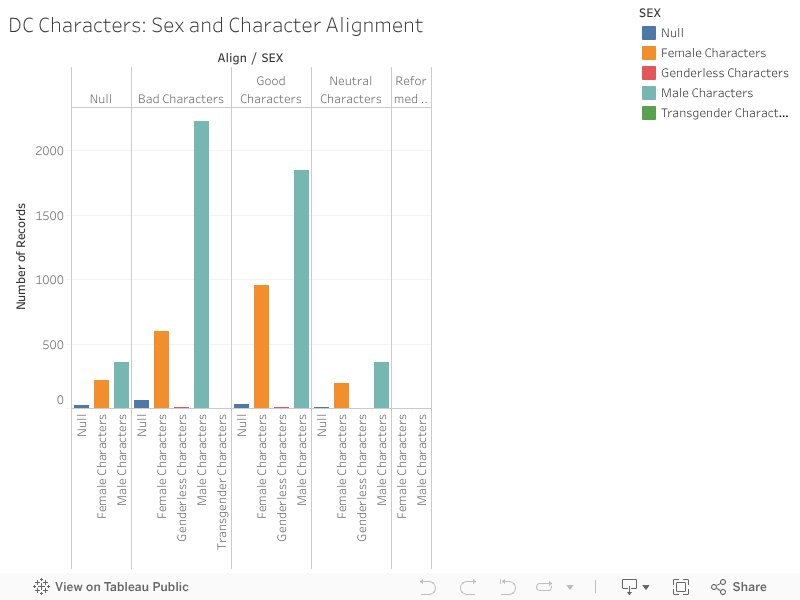
For this blog post, I analyzed DC Character data, a part of my group’s final project data set, to look at the relationship between the character’s sex (null, female, male, genderless, and transgender) and their alignment (good, bad, null, neutral, and reformed). I used Tableau to create a bar chart that parsed out the number of records we had. The various colored bars indicated the sex listed for each character: blue for null, orange for female, pink for genderless and turquoise for male.

As we can see from the chart, there is a high proportion of males to other character sexes. When looking at my data visualization, I can see this more clearly than looking at the data. I can also see that there are more bad characters than good. There is less of a difference in the male-female ratio for null or neutral labeled characters but it may also indicate that there are just a fewer number of those characters. The visualization shows that there are few genderless characters and no transgender characters. All or no gender is considered in the data but not all are necessarily represented. That was an important decision that the archivist compiling the data made and decided to include.

However, I cannot see the reformed characters data. It does not list the other genders as options (such as null, genderless or transgender) which means it was not recorded. It could also mean that I would have to clean and filter my data more precisely.


LA Controller: City Budget Expenditures

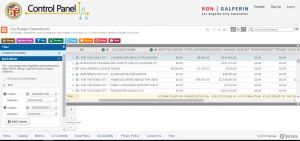
The City Budget Expenditures data consisted of financial data shown by the budget fiscal year since 2012. It includes the Los Angeles City Budget, Adjustments and Expenditures as the LA City Controller has documented. Its data types are the Budget Fiscal Year, Department Name, Fund Name, Account Name, Adopted Budget, Total Expenditure, Budget Change Amount, Budget Transfer In Amount (increase in appropriation to account by transfer in of funds), Budget Transfer Out Amount (decrease in appropriation to account by transfer out of funds), Total Budget (appropriation account amount net of changes and transfers to/from the original budgeted amount), Encumbrance Amount (obligation or commitment to pay for a good or service), Pre-Encumbrance Amount (Anticipated obligation or commitment to pay for a good or service), Budget Uncommitted Amount (Total unused appropriation after expenditures and encumbrances), Account Group Name, Fund, Account and Department Number.  Then, for all the budget information, there is a total section that includes the total money spent for each of the budget categories. A record in this dataset is each expenditure a department makes and the changes that they make to their budgets. This is important in seeing how they allocate and spend the funds provided by the city of Los Angeles and taxpayers’ money.

Wallack and Srinivasan’s definition of ontology clearly indicates that it is “systems of categories and their interrelations” (Wallack and Srinivasan, pg.1) that people use to deal with information and understand the world around them. This dataset’s ontology creates an understanding of the money that is used by the city of Los Angeles based on budgets that are set. It means more transparency of government funds which allows for trust and hopefully ethical and honest expenditures. The taxpayers and residents of Los Angeles would find this data most useful and illuminating. However, I also believe that this data would be helpful for each department’s accounting team and the LA Controller to prepare and keep track of the budgets for that year and the following years.

The dataset can tell us a lot about where our money goes and how it is generally used. Most of the funds go towards resources for the elderly, neighborhood empowerment/ neighborhood councils, administration, salaries, among other things. It also shows that amending budgets based on certain expenditures and re-allocating money is proper procedure as long as each transaction is noted and correct. The way in which the information is provided and the options available, allow for the viewer to interact with the data. There are different tools and ways of looking at the data (visuals), you are able to filter through the data to find something in particular, you can export the information and you can also make comments to discuss with others viewers.

2016-10-17

As far as I can tell, the amounts and expenditures that they list are grouped expending greater amounts ranging between hundreds to thousands of dollars. This means the data that is left out are probably small expenditures that either get grouped into a record or noted in some other way.

If I were to start over with data-collection with a completely different ontology, I would start by using different data types. I would take into account the justifications for certain expenses and be more specific on certain charges, especially for generic expenditures like: travel, transportation, etc. I would also include a section for the aspect that it would pertain to most: health, education, well-being, administration, etc. I think people would appreciate knowing and sorting through these more broad categories for how money is spent It can also give a more general idea of the expenditure areas.

Archives: The Glen Keiser Collection

The Glen Keiser Collection of Comic Books, Fantasy Drawings, and Realia, 1940s-1980s consists of comic books, fantasy drawings from various publishers such as Marvel, DC Comics and other independent publishers between a span of 40 years. It also includes books about comics, oversize comics, paperback books, realia, mounted pictures and items labeled as “Other”. Each of these items are listed under these individual subcategories in alphabetical order. The finding aid gives an overview and scope of the collection, specifies the contents of the collection (however, it does not list each item individually) as well as its arrangement, where the location is stored and notes on restrictions on its use and reproduction.

Based on this archive, I would not be able to tell much besides the collector’s interest in comics and related items. Glenn Keiser was drawn to Marvel Comics and DC Comics as this is a majority of his collection. Because of the manner in which it is listed, it is difficult to come up with a narrative or context in which he collected these items. He collected items related to the comic series such as tee shirts, cards, 3-D glasses, Cerebrus medals and mounted pictures which indicate his desire to collect more than the stories but the material culture that is associated with the fan following of these different comics. Unfortunately, these are not specified on its relation to a certain comic or character.

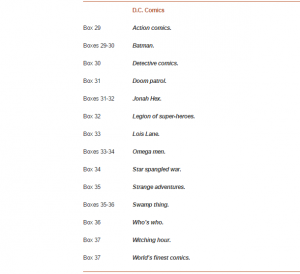
It would be beneficial to have the exact dates and a brief synopsis of each of the comics. This would allow people that are unfamiliar with the titles to analyze and understand the collection: similarities, differences, etc. Also listing these by date would make it easier to understand the collection as a whole much better. Currently, the collection is listed by category or publisher and then alphabetically (see image below). I suppose the number and size of the boxes labeled with each of these comics would indicate the size of the collection and be helpful in finding the exact location of an item you are looking for. This is helpful when looking up a specific title but not so much when coming up with a narrative or context for the contents.

2016-10-09-2


A description of the owner/ collector may give us a better picture on the kind of person that collected these items and the thought process behind it. Images of the covers and items would make it easier for someone to confirm it is the correct item. Images can also give more information on a lot of other factors like the condition of the items and the style of artwork, color, etc. that may indicate something of the time.

Dissecting Photogrammar

Yale’s Photogrammar site aims to digitize the 170,000 photos taken between 1935-1946 that are maintained and cataloged in the Library of Congress. Photogrammar allows users to search these photographs using Paul Vanderbilt’s Lot Number system and Classification Tags system. The collection available online includes photos from six different collections.  Most of the collection is the Farm Security Administration Collection and the Office of War Information Collection (including Domestic Operations Branch and Overseas Operations Branch photograph files). However, there are also photos from the Office of Emergency Management-Office of War Information Collection that focuses on the News Bureau photographs, the American at War Collection, and the Portrait of America Collection.

The Photogrammar website is clearly labeled and easy to navigate through. The homepage begins with a breakdown of what is offered on the site: what the collection is about, an interactive map and data visualizations. The tabs at the top can also get you what you want immediately. You can toggle through the maps that trace the routes and the locations of where each photographer took his or her photos. There is even a start exploring button that will bring you directly to the maps. 

2016-10-03

Sources: The collection is comprised of six different collections currently housed in the Library of Congress. Those collections are listed above but a majority of the photos are comprised of the Farm Security Administration Collection and the Office of War Information Collection.

Processes: The creators of the site used the photograph collection to create amazing data visualizations of Paul Vanderbilt’s classification system (Treemap) and an interactive dashboard showing the relationship between date, county, photographer, and subject in photographs from individual states (Metadata Dashboard). They are currently working on analyzing the colored photographs based on hue, saturation and lightness which should be out soon (ColorSpace). They used the information from the classification system as well as the photographs themselves to create these. The maps utilized and referenced Photogrammar’s own site and digital collection when referring to the photographs each photographer took (bringing you back to a different part of the site).

Their own blog provides more context and background content of the photographs and sources they used. It also goes through their research process, thoughts and deeper analysis of the photographs while exploring certain aspects of their collection.
Presentation: The presentation of the interactive maps were made on Leaflet, an open-source JavaScript library for mobile-friendly interactive maps. The creators also used CartoDB attribution. They allowed their site to be web-accessible and the content that they displayed searchable on Photogrammar. It was also made interactive by including interactive maps and an interactive dashboard which allows users to search and explore the collection on their own. Although there were 7 people working on the site, the information that they displayed was unified and unless I clicked on the About Team page I wouldn’t have known the number of people that collaborated on it.