The “Gender Breakdown of City Works by Department” data set is a collection of information regarding the proportions of males and females working in different government departments. It also includes other data examining total payroll per department, total male and female salaries compared, average salaries per man and per woman, and the percentage of each department’s payroll that goes to males and females. For each of these categories, the data can be sorted into pie charts, line graphs, tree maps, and other forms of visualization. It is easy to discover, through manipulating the data, how many men versus women are employed overall and by department, and how their total and average salaries compare. A record type in this data set would refer to all of the information compiled from a particular department of city works.
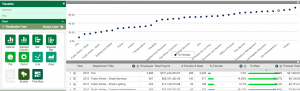
According to the article by Wallack and Srinivasan, the meta-ontology of this data set was created by the city to monitor the hiring demographics of each department according to gender and how their salaries compare, in order to ensure that there aren’t any alarming disparities that might point to gender discrimination. However, this data gives us no context as to the culture within each city department and whether or not that culture impacts the gender ratios and salaries of that department’s employees.
A city policewoman might claim that women who want to be police officers face discrimination (28% women in the police department), while a fireman might claim that men have a difficult time getting hired in safer and more stable departments (finance and city attorney are both majority women) and are instead shunted into departments that are more dangerous, low-paying and labor-intensive (sanitation, fire and building safety are all overwhelmingly male).
From the point of view of a person who is advocating against gender discrimination in the work place, there is a lot of useful data in this data set but also a lot of information that has been left out. The fact that a man’s average salary is higher than a woman’s average salary in very nearly every city department would be concerning to this person, but there are other factors that could be skewing this data. For example, a record that shows one of the greatest disparities between male and female average salaries – the Department of Convention and Tourism Development, with $145,000 for men and $54,000 for women – only has fifteen employees, which suggests that the disparity would be significantly smaller if there were more employees to balance out the data.
For this person, information showing the number of discrimination complaints lodge annually per department would be useful, because that data could then be compared to gender disparity in the departments to see if there is a correlation. Additionally, data showing the proportion of males and females in positions of leadership in departments would be useful, as it might provide more social context.
Your example of the female police officer, male fireman, and occupational culture is great at providing a concrete example of how this dataset can be taken further and utilized by different members of the government. I also think your proposal for providing the number of filed discrimination complaints would be a great indicator for both meta and community ontologies. I would be interested to hear how you think this could be useful to other members of the community that aren’t involved in government affairs, and how they could use this dataset!
Great analytical post! This was written clearly and concisely, and I appreciate how you support your speculations and hypothesis with strong evidence from the data. You used good examples showing how the data can show discrepancies and possible discrimination with the more difficult occupations vs the less-laborious occupations, and also how the number of employees could be a major factor of such discrepancies.
I explored this same data set, but never thought about how cultures within departments could lead to differences in the number of male vs female employees. I also like your idea of including a row for filed complaints, and I think that could be really useful for women’s rights groups or other equality coalitions. I agree that leaving out how many males/females have leadership roles is probably leading to a skewed interpretation of these numbers, which I assume is very unwanted on the LA Controller’s Office part. Your thorough analysis was a great to read!