This week, I looked at data about the Top City Earners from the LA City Controller’s website. This data, as the name implies, looks at who the top earners in Los Angeles are (using data since 2013), plus a break down of their salaries. Its data types are the types of pay (Base pay, Overtime, etc), Pay (in the hundreds of thousands), and occupation, ordered highest paid to lowest paid. One record is the salary of a particular occupation. The record is then broken up into smaller parts in order to more accurately see how the salary gets to the number it is (ie how much is earned from overtime? Bonuses? Base pay?)
When looking at Wallack and Srinivasan’s definition of an ontology, which is primarily “systems of categories and their interrelations” that groups use to establish order and manage information about the things around them. This dataset’s ontology looks at how different types of pay (Bonus, base, overtime etc) can affect the overall total salary a particular occupancy gets. For instance, the base salary of a Fire Captain I is only around $120K, but their total salary ends up just shy of $450K because they were paid around $311K in Overtime, unlike the Chief Port Pilot II whose base salary is $211K, but worked no overtime.
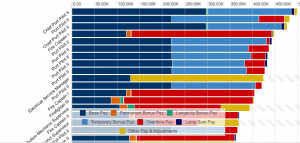
When looking at this dataset, people who would find this ontology the most illuminating/useful would be someone who works with the city’s budget, and would want to know how the funds allocated to pay were being distributed. There are trends that emerge when you look at the top 10 highest paid positions – they work less overtime on average (the Fire Captain I position aside), and seem to make a lot of “temporary bonus pay” (the light blue). Thus, the people in charge of the budget would find the division of types of pay useful for seeing how they affect one another, and if adjustments need to be made.
This data tells us that port pilots seem to make a lot of money (they make up the majority of the top 15 earners), and that while the base pay may not be /extremely/ high, other things such as overtime and bonuses almost double their total salary. However, this only tells us that this phenomena occurs, but gives no indication as to why it is so. Going back to the previous week’s topic of narrative, this collection has no distinct narrative that can be formed from looking at the data.
If I were to start over with the data collection, I would take into account how many years of experience each position requires, as well as how long each person at that particular post has held the position. It would contribute to the ontology by giving reference to how longevity of their time in their particular field can contribute to the type of income they receive.