 Inventing Abstraction, 1910–1925 celebrates the centennial of Abstract Art as an interactive website accompanying a MoMA exhibition of the same title. Although the physical exhibition was only available from December 23, 2012 to April 15, 2013, the online display continues to educate viewers on the origins of abstraction. By demonstrating the emergence of abstraction in the form of a network connecting modern artists across countries and media, the exhibition relates to the most influential works in the early stage of abstraction in a broad range.
Sources:
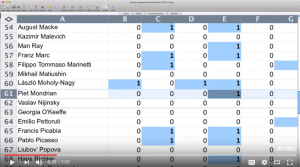 Organized by Leah Dickerman, Curator, with Masha Chlenova, Curatorial Assistant, Department of Painting and Sculpture, the exhibition includes paintings, drawings, books, sculptures, films, photographs, sound poems, atonal music, and non-narrative dance to draw a cross-media portrait of early abstraction. The curators selected works of 92 artists who were active during year 1910 to 1925, and created a spreadsheet consisting the information of all of the aforementioned artists to determine the representative works and social networks on display. The selected artworks were photographed, scanned, transcribed, recorded, restored, shipped, and installed to integrate into the exhibition. It is revolutionary that wide ranging sources, including early dance films and recordings of poetry and music, are brought into the galleries of early abstraction. The unprecedented collection of American vanguard art works is also groundbreaking to witness.
Processes:

The process of the exhibition was achieved via MoMA staff’ creation (including the curatorial and design team ), as well as the support from the Columbia University Software and Second Story.
On the one hand, the The Artist Network Diagram was a significant component of both the interactive interface in the website exhibition and the outline of the physical exhibition. Its creation started from curators collecting the literal description of selected artists and their relationship. Scholars in the Columbia University then constructed a digital dot-graph based on the original chart. Furthermore, graphic designers sorted out a visually organic improvement on the graph. It was the 1936 MoMA exhibition Cubism and Abstract Art and the now-legendary diagram on the cover of its catalog that offered inspiration. Designers incorporated the Alfred chart (Alfred H. Barr, Jr, the founding director of the MoMA) with the concept of social network. Thus, a comprehensive network graph of early abstraction artists was made.
Second Story, on the other hand, contributed to the process by coding the sources and data into the network frame. Creating an interactive diagram which enables the viewer to compare, relate and learn the artist information, artwork and conversations, the tech team utilized their mastery in programming to make the virtual exhibition possible.
Presentations:
 Inventing Abstraction, 1910–1925 offers a multimedia visualization of the origins of abstraction. Suggested in a diagram, the spread of abstraction is about relationships and collective participation. The website presents a dynamic, 3D diagram of the connections between the artists, so that as visitors interact with the diagram, they can explore detailed networks, view artist portfolios, and draw their own conclusions about influence, impact, and invention.
 The home page offers a brief introduction of the exhibition theme and the diagram to the viewers. By clicking Explore Connections, the viewer will enter the most essential part of the website – connections in between the artists. On the left and right side of the website, there are two virtual buttons available for control: return to the previous page and a changeable scale. Such designs facilitate users’ experience when switching from different connections. There are two navigation bars at the top and bottom. The primary navigation includes links to Connections, Artists, Conversations, and Programs & Events, while the secondary navigation leads to About the Exhibition, Network Diagram, Checklist, Publication, Music, Blog, Credits and MoMA.
Clicking the “Artists” link offers viewers an alphabetized list of featured artists, with the essential ones highlighted in red. Clicking on an artist’s portfolio enables viewers to examine detailed information about the artists and his/her artwork.
Awesome job! Such an amazing way the project organizes and displays a massive amount of data and also includes narratives to put the data in context. I like that you included so many different screenshots. Great explanation as well!
I really appreciated how much effort you put into presenting the information related to the website, like the curators and all of the organizations involved. While they did not directly help me to navigate the site like your descriptions of the various presentations did, they helped me gain a broader understanding of the project in its entirety and what it was intended to achieve. This allowed me to appreciate the content of the website more.
Your blog post was so well organized and easy to read! It flowed perfectly and was very clear throughout the introduction, sources, processes, and presentations. Each topic had the perfect amount of information, and you made it really clear and easy to understand. The clear headings and multiple screenshots of the website are a very important detail and nice touch! I did not explore this website to the greatest extent because I chose to explore another project, so I really enjoyed reading your post to get to know exactly what the “Inventing Abstraction” project is all about. Great job!
You did a great job on reverse engineering the “Inventing Abstraction” DH Project. I did not use this project for my own blog post, so it shows how great of a job you did in explaining how the website was constructed because I feel as though I understood by your summary. I especially liked the screenshots you included of the Sources, Processes, and Presentation explanations because it provided a visual for your statements. I also enjoyed your explanations of the links on the different pages!
Great post! It’s really impressive how well you deconstructed this DH project. The only thing I wish I saw was what you thought of the project. When I saw the website I definitely had a hard time understanding the network/connections in the first screen shot but you explained that well. It’s incredible how broad and multimodal their sources and processes are. It seems like you agree with their method of processing and presentation to show things in a detailed network in order for viewers to “draw their own conclusions about influence, impact, and invention”, and I agree!
This post gives a detailed, clear, and thorough explanation of the project. It’s interesting to see the wide range of sources that went into this project, and this website shows how abstract art is much more collaborative and connected than one might initially think. I also think it’s cool how the design of the network is influenced by the Alfred chart. The collaborative spirit of art influencing other art is not only represented by the social network displayed, but by the design of this visualization as well. The names highlighted in red makes the somewhat overwhelming chart more accessible and easy to read as well, which I appreciate. Lastly, being able to see not only the artist’s work, but also read about there story adds a vital narrative aspect that allows the user to better understand the stories and interconnectedness of this community.
I did not do this for my project, but I really loved reading your blog post. It really showed the thorough, detailed, specifics of the project. Its amazing that this technology allows people all over the world to see the pieces of art that may not have access to the physical pieces at a museum. This allows people of all socio-economic statuses to enjoy art, which is a major component of the cultural integrity of art itself. Throughout history, art was enjoyed primarily by the upper class wealthy people, but now its available to everyone and anyone which is amazing. The incredible portion of this project itself was its ability to interconnect seemingly unrelated pieces of art.