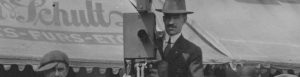
The “Early African American Film” project explores the history of silent race films from approximately 1900-1930. The project focuses on a segment within film history that is seldom examined: the silent films created prior to 1930 for African American audiences. This is a topic that not many are familiar with and therefore proves to be a very intriguing.
The project acknowledges that the term “race film” itself has no strict, defined boundaries but instead encompasses a large variety of films based on different criteria such as having an African American cast, produced by an African American owned company, or made for exhibition in African American audiences. Using some basic criteria, the project team started with a wide set of films and then reviewed film by film to reach a narrowed down list. The primary and secondary sources used to create this project were gathered from several archives from the George P. Johnson Negro Film Collection in UCLA’s Special Collections, Mayme Clayton Library and Museum, and other centers.
The aim of this project was to create a database of these silent race films and their accompanying details. Relational databases were made using Airtable. The database includes four different tabs with information about the people, films, companies, and sources. Specifics such as actor and director names as well as the race of the production company owner of each film is provided. The site has the option of filtering and grouping entries to make searching and seeing connections between entries all the more easier. Furthermore the database comes with a data dictionary so there is no room for ambiguity.
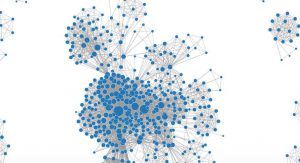
The presentation in this project is done through a variety of visualizations. Information about the production date of films is presented in a histogram format which was made using plot.ly. Two very appealing network diagrams show the connections between different people associated with the films, and the connections between people and the films themselves. It is very easy for users to visualize not only who is connected to who, but also the strength of connection (depicted by the thickness of the connecting line) and people who have the most number of connections (depicted with larger nodes). This visualization is very easy to use and facilitates the visualization of the web of connections among various people in the industry. It was created using Cystoscape. To see this network diagram, click on the image. Additionally, the project uses a time map created with CartoDB to demonstrate trends of when production companies were founded.
Overall, this project does a wonderful job educating users about the silent race films produced before 1930. The site is well organized and very intuitive to use. Especially unique about this project is that it encourages people to download its data and perform their own modifications on it. Furthermore, the site actually provides tutorials detailing how to make the different graphs and visuals they created. This is a great learning opportunity and allows for users to understand the data at a greater level by actually reproducing the visualizations.
You did a thorough job explaining each aspect of the project. Particularly the paragraph discussing the visualizations of the project was effective in the breakdown of the maps and their importance within the project. I also thought it was important how you mentioned the uniqueness of the project and how it is different from other digital humanities projects in that it encourages the viewers to learn and modify the project’s data on their own.