I recently visited the Los Angeles Municipal Art Gallery, which has an exhibit under the title “Ours Is a City of Writers” on display this month. The exhibit focuses on the interdisciplinary practices of making art as a writer and writing as an artist. The gallery space was full of technology employed as art, with video installations and print booklets and leaflets. Patrons of the gallery would grab the booklets and leaflets, but would rarely stop and read the text in full. I think these supplementary items existed sort of as souvenirs, which would help patrons look back and reflect on their experience. Of course, this is part of the gallery and art experience as well, to treat the print media as an extension of the gallery space. The artist’s ability to create the printed content extends beyond the gallery into how the exhibition is remembered. This ability to have influence over memory applies too to any additional online media content that addresses the exhibit, in news media, or social media. Interestingly, there was a display of a diverse set of printed media, all political texts from books of essays, novels, and news magazines. These pieces of media were on display, and therefore not to be looked at. In one instance a child reached out to grab one of the books in reach, and quickly was reprimanded by a worker at the gallery. It was interesting to see here which texts were deemed part of the art that could be interacted with, and which art could not be interacted with. These texts seemed then to act as a sculpture would, as a piece of art that shouldn’t be touched by the viewer.

A big portion of how this exhibit interacted with technology was through a website, where patrons and non-patrons can access writings by the included artists. www.oursisacityofwriters.net extends the gallery space further, into an online exhibit. Here artists contribute their essays, poems, and self-crafted pieces of print media that one could consume at their own leisure. The online space is at once highly curated and self-curated: as everything down to the code and content of the website is determined by the curators, but the ability to interact and choose what is viewed makes the experience feel catered to the viewer’s taste. Again, memory of the exhibit space is crafted here on the website. I found myself clicking on the artists’ pages that I was most familiar with, and gravitated towards the artists that made the biggest impression upon me in the gallery space. In this way, the website reinforces my vision of the exhibit. This is not to say that it doesn’t also introduce me to new experiences. In a way, I think the website has the potential to make me want to revisit the gallery, with the added dimension in my mind. Containing mostly writing, the online exhibit seems to fall in accord with how most people access written media now: through the Internet. Here, the exhibit took a new form for me, more personal and yet more distant than the gallery.
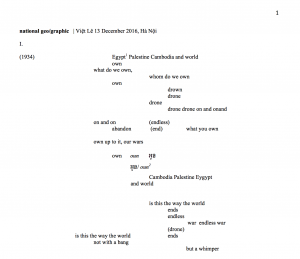
Though I would have liked to hear more about how technology was utilized in the physical exhibit, I do agree that the use of an online exhibit helps to enhance the experience, whether that is to give potential visitors a glimpse at the type of work that the artists produce, and that would be on display, or offer additional media for the those who have visited the physical space to explore, and expand their contextual understanding. Look at the pieces online, they are all generally short and consumable, presented in a site with minimalist design. I agree that this does well to invite, as well as reinforce.