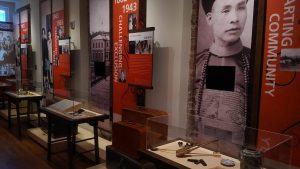
On Saturday, February 11th, I visited the Chinese American Museum near Chinatown for the first time. The museum consisted of three small floors with the main gallery depicting an overview of historical events in Chinese American history. Each of the cases in the main gallery had objects that belonged to individual families when they first arrived to America. There were four screens but only two of them were on. Both screens showed images of the families whose items were highlighted in the cases. They also displayed interviews and discussions about their experiences to implement the oral histories with the physical objects. However, the speakers were not working and the subtitles were in Chinese (which I was unable to read and understand). Others in the museum took their time looking at the objects and briefly watched the videos. I think they would have been more engaged with the digital aspect of it if the speakers worked.

On the second floor, the screen was hidden in the back in what looked like a collaborative space with a table. It also wasn’t on but I’m assuming it would have had content about the expansion of the Monterey Park area like the other content in that section.


The third floor also had a screen that played what looked like old family videos from the 1960s and 1970s.


When I asked Trent, the front desk greeter, about the digital technology at the museum, he explained that sometimes their screens do not work because of the lack of funding and the dated technology in the space. They said they had a hard time keeping up technologically and those elements became tedious because it was costly to maintain the software and hardware. There weren’t too many digital elements in the museum. Only two other screens were visible on the other floors.
Trent informed me that sometimes their temporary exhibits incorporate digital technology. In the past, they had interactive computer screens for people to use. Each of their temporary exhibit curators have the flexibility of using the technology or not. The curators and donors choose whether or not to use it in the permanent galleries.
In this particular museum, most of the people spent their attention and time on the written text. Because it was a cultural-historical museum, it was crucial to read the text to give context to the objects that we were looking at. There actually weren’t that many objects on display. Most of the content was text heavy. A complete wall of text and the in depth timeline was a bit overwhelming but they also added photos and highlighted events or people which helped. I noticed most of the visitors didn’t spend too much time reading it. Even the objects, with very little captions, were not looked at for very long unless there was writing or it was something intricate. Many people came in pairs or in groups. I saw them interacting with each other while talking about the material or looking at it together. The museum isn’t that big so people went through the entire museum pretty quickly. It was nice to see that visitors were engaged with the material and history in some way. I felt a strong sense of belonging as well as an attraction to these objects and their background because of my Chinese-American roots. It was great to visit a museum that focused on this and allowed people to interact with what being Chinese American meant to them (see photo).
It’s great that you were able to seek out and find digital components, though they did not always work. I am glad you were able to speak to the staff and get more insight into their utilization of the technology. It is unfortunate that they do not get enough funding to maintain the functionality of those digital devices. Perhaps they tried to increase the use of text, due to the shortcomings of the digital portions of the exhibits.
It was interesting that the staff member was able to give you some insight on the digital components of the museum. Technology advances so fast that it is no surprise that smaller museums such as this one have difficulties maintaining digital components. The text in the museum seemingly made up for the lack of technology as it was in abundance to provide the audience with historical context. Thanks for sharing your experience!