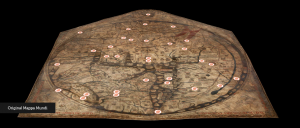
Mappa Mundi Exploration revolves around unveiling the interpretive potential of Mappa Mundi (shown above), a highly valued, historical artefact currently stored and protected in the Hereford Cathedral in the United Kingdom. The project aims to learn about Mappa Mundi’s creation and showcase what the 700-year old artefact has to say about how the early 13th and late 14th century Christian Europe’s understanding of history, geography and destiny of humanity.
If you are unfamiliar with Mappa Mundi, fret not. I personally have not heard of this artefact until I started exploring the project website. In essence, Mappa Mundi, which is the source or the raw material of this project, is a 5’2″ by 4’4″ map. That’s quiet a huge map, it’s as tall as I am! Briefly speaking, Mappa Mundi jam packs a whole range of information in the form of drawings and writings onto what is thought to be the skin of a large vellum. The contents of this map summarizes the inhabited part of the world that was known then and reconciles the earthly with Christianity. To get a better picture of Mappa Mundi, click on the picture above. It should link you to the Mappa Mundi project, where you can see how Mappa Mundi looks like.
What is interesting about Mappa Mundi is the amount of information it contains and how it was made, which are what historians have been dissecting as well. To do that, they have devised methods to process Mappa Mundi. One of the most recent processing methods was done using Lucida 3D scanners, which involves laser beams onto Mappa Mundi. Wait, lasers? I’m not a historian, but I do think lasers might damage in seconds the artefact that humanity has been trying to conserve for centuries? Luckily, the team in charge of this, Factum Arte, had cautionary measures like using low intensity laser and ensuring no-contact scanning by securing the scanner to a mobile and firm platform. The scanning process is recorded continuously using black and white video cameras, where each frame is then processed to creating the high resolution 3D form. In addition to the 3D processing, a team from The Folio Society also generated a color-enhanced version of the map. As a result, geographical features like water and mountains, can be clearer.
There is rich history behind Mappa Mundi, and these historical insights is unveiled by how the project presents Mappa Mundi. The Home page lays out the scanned, original Mappa Mundi with circular “dropped pins” scattered throughout that mark key informational points on the map. In terms of displays, one can choose from three options: original, color-enhanced, or 3D. In terms of exploring the map, one can choose from two options: click the dropped pins or browse by category of information.
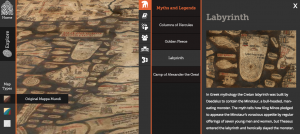
Firstly, clicking on the dropped pins will simultaneously zoom into the specific portion of the map and expand a menu bar showing categories of information. This menu bar shows categories, which facilitates the second way of exploring the map. Browsing by category of information will simultaneously show the relevant information while shifting the map towards the specific portion of the map (as shown by Figure 2). There are six categories of information, including “Myths and Legends,” “Bible Stories,” and “Beasts of the World.” Under these categories are sub-categories, such as “Noah’s Ark” and “The Red Sea and the Exodus,” under “Bible Stories.” Such interface of the web page simplifies navigation through the complicated and jam-packed original version of the map, which in itself is a greatly applaudable feat.
By the looks of it, the project is not necessarily done yet, as demonstrated by the development of new methods of processing to deepen our understanding of Mappa Mundi. Overall, the project has successfully made it possible for the general public to both access and understand the wealth of information that the map has in store. Try it out yourself! It may surprise you how seamlessly you could learn about the exhibit through your computer.
I liked how the Mappa Mundi had the six categories you mentioned; I think it’d be even better if they expanded on those categories and had even more medieval beliefs about the ancient world!