One of the special collections that I have used in the past from University of California, Los Angeles Young Research Library is the Los Angeles School Board Records from 1875 to 2012. The historical narrative that you could construct from this is limited to the information available in these documents. This particular archive has information that could help craft many historical narratives on education in Los Angeles County. It could be used as a case study alone or specific years could be looked at as part of a larger narrative.
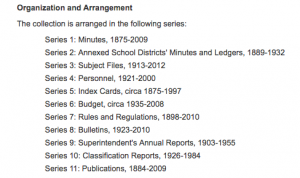
Screenshot 10/16/17 Showing the Organization and Arrangement of the Data
There is a lot of data on the minutes for school board meetings that could help craft a story about education goals of Los Angeles Unified and how they changed throughout the years. You could do a frequency of how often certain topics were discussed and how much time the school board spent discussing it. The school board budget data from 1935 to 2008 that could tell a story about how the school board spent there money and how it changed over time. This could add lend itself to a historical narrative of cost of labor, cost of food, and other school related expenses in a micro context. Another kind of records they had were school rules and regulations 1898-2009. This could be used to understand expectation on students and teachers enforced by this district. For example you could see how teaching methods have changed over time as well as information on child labor. Question such as: how much school children were allowed to miss? What could children be punished for? What were expectations and limits for teachers in classrooms?
Last year I did research on the 1947 law case Mendez vs. Westminster therefore have already looked at this archive in some detail for the minutes of the school board from late 1940’s. I was trying to uncover what the board was discussing in regards to integration into schools. I figured that school board meetings would have to discuss this historic decision because of LA’s diverse population. At first I was so excited when I found this.
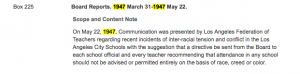
Screenshot showing the information that pertained to the specific research I was looking for.
I thought this is going to be great evidence for my paper! So I scheduled to look at two boxes before and two boxes after Box #225. I was greatly disappointed by the scope of the data that I found. In those meetings what was said above was about the total information said about the subject of integration of Los Angeles County. Not much more information was provided. I not able to uncover much information about the integration of students on to campuses in Los Angeles School District within the boxes I had gotten. I realize now that minutes in school board meetings are very limited in scope and do not give a full details about everything that the School Board decides/discusses. So the gaps that this data had for my own personal project were lack of detailed specifics discussed in the meetings. To get the information I needed it might have been better to look at the rules and regulation. Perhaps I would need internal memos or letters. First hand accounts would also have been probably more helpful to getting the information I needed. Unfortunately I believe that some of the specific information that I was looking for may be lost in history. Thinking back, maybe it was naive to think that there would be complete transcripts of what I was looking for. However, I think that this was a learning moment for me because I realized that I would need to put way more time to get the information I needed from this archive. Also the means of procuring this information was stored and accessed: by ordering the boxes, scheduling the appointment, and finally physically going to read the information makes it hard to search for the kind of data I was hoping for.
I like how you considered and described multiple different narratives that were completely different but that could all be created using the same set of materials. Your connection of this archive to your personal experience also shows how archives aren’t just collections of old, historical materials which sit in a museum, like many people think of them, but rather they are actually very important for constructing and learning about a wide variety of narratives. The reflection of gaps in the archive was very thorough, and showed me how the decisions we make of what to preserve and not to preserve really does make a difference!
While it’s understandable that decades past may not have had as detailed minutes, do you think that today’s advances in technology (specifically speech recognition) would improve the narrative of the meetings? Or instead do you think that a full transcript would create more of a positivist view?
I think that a full transcript of the meetings would have been the best way to understand what happened during the actual school board meetings. LA’s school board meetings happen so that people in the present can solve issues affecting their schools. It would be way beyond the board’s scope (though would be awesome piece of history) if there was a complete transcript. First hand accounts maybe through historical interviews or letters would need to be used in order to reach the voices and narratives I was looking at for the research I was doing.
I am astounded by how many different narratives you were able to come up with based on the information present in the collection. Likewise, I applaud the fact that you gave an example of how this information could lead to research questions. You suggest that we need to streamline the methods by which we procure this collection, so my question is: what do you believe will be the direction technology will head towards in digitizing physical data?
I mostly just hope that more data is digitized because it will give people (who maybe cannot head down to UCLA Young Research Library) more access to information pertaining to their research. I don’t know how likely that would be but it would make accessing data faster and more efficient!
This is so great, Samantha! It’s really useful to hear the voice of someone who’s actually worked with the archival collection in question. Your experience really resonated with me. So often I’ll have an elaborate idea in my head of what an archive will contain, only to be totally surprised or disappointed when I actually open the box. I guess that’s part of why people love archival research — you never stop being surprised. Your blog post reminded me of this interview with the historian Marisa J. Fuentes (which I actually considered assigning instead of the Trouillot piece). It’s all about how you can tell history, even amidst all the gaps and silences in the archive. What do you think, should I assign the Fuentes piece next year?