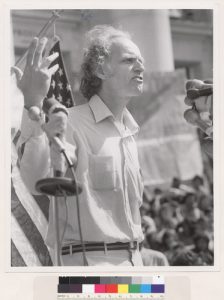
In the mid-1960s, a massive student protest lasted throughout the entire academic year at the University of California, Berkeley––now known as the Free Speech Movement (FSM). It was informally led by graduate student Mario Savio, who appears in the photos from the Photographs of the 1984 Free Speech Movement Memorial Rally, 1984 collection.
The students who joined the Free Speech Movement fought for the Berkeley administration to lift the ban on on-campus political activities and thus acknowledge the right for students to exercise free speech and academic freedom. After much protesting, the university officials slowly surrendered. By January 3, 1965, the new chancellor, Martin Meyerson, initiated provisional rules for political activity on the UC Berkeley campus. For instance, the Sproul Hall steps became the designated area for open discussion––for the entire student political spectrum––during specific hours of the day. The Free Speech Movement was such a pivotal moment for the civil liberties movement in the 1960s, and even paved the way for future protests including the ones against the Vietnam War. Overall, it sparked the student activist spirit that still exists on the Berkeley campus today.
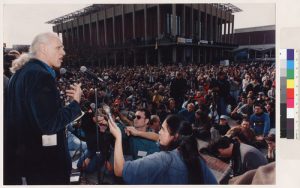
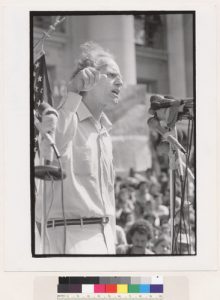
In order to address these gaps, there needs to be more sources on the background and history of the Free Speech Movement, as well as how Savio rose to become the central leader for thousands of students. The Movement was the “first mass civil disobedience in college campus of the United States during the 1960s,” which is a significant occurrence and one worthy of having a more abundant collection. On the Wikipedia page for the Free Speech Movement, there are a few valuable primary sources: a photograph of an article about the Memorial Rally and another of Mario Savio leading a rally on the Berkeley campus in 1966. The collection currently focuses on the Memorial Rally in 1984, but the Free Speech Movement deserves a larger, more noteworthy collection.
I really liked how you provided the background story before introducing us to the collection. I also liked how you included all three of the photographs. It definitely would’ve been more interesting to learn about the personal experiences of the students who were at the rally!