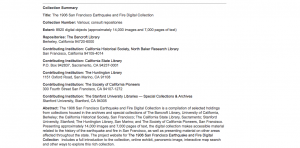
I really enjoyed the collection presenting the 1906 San Francisco earthquake and the resulting fire. There is an extensive set of photographs and multiple landmarks and locations were photographed documenting the catastrophe that happened. Throughout a tragedy there is a lot of memories left, while most are unpleasant, someone has to do the unfortunate job of recording what they can. This is not to forget the past and disacknowledge it; though the tragedy that took place was extremely unfortunate for many families, many people still revisit the memories through old photos and journalism. The idea of keeping memories is not to continuously haunt oneself, continuously reminding oneself of their losses and how cruel nature can be, but it is a way to sort of come to terms with what happened -to ultimately accept it and be able to progress. It is important to find closure and move forward with one’s life. The passed down memories and keepsakes serve also as a reminder to live life to its fullest and to make sure to not have any regrets. No one knows what day will be their last, it may be gradual or abrupt.
However, no recollection and dataset is perfect and this one is not an exception. First and foremost, we are limited by inferior technology as the earthquake happened over a hundred years ago. The lenses and photography equipment could not possibly capture the detail and scope that would be considered exceptional today. Another obvious flaw is the lack of colour in the photos. With colour, the photos would have an added dimension, and the damage/landmarks could be easily differentiated and analyzed. This could be crucial in missing out on the surroundings around each subject, people and other objects in the background, etc that would contribute little pieces of the story that add up to form a better big picture.
On top of this, one can even say video would have been preferred as it would’ve been able to capture a recollection with a viewable timeline. Modern news live coverage would have also been preferred because on top video, there are live reactions and emotions being expressed as well. There would also be more perspectives, rolling shots and footage and just overall a much better recollection and dataset of events and landmarks that were affected. Overall this is a very good collection for its time and most of the “flaws” are things the photographers couldn’t do anything about.
Hi,
I agree with you when you said that these photographs documenting the tragedy are not meant to serve as constant reminders of loss but rather as a form of closure. I also believe that it is necessary to document these instances because, although unpleasant, they are still important historical events. Similar to you, I’m also curious as to how this collection would be with modern news live coverage and photography compared to the 1906 technology that was available.
Overall, great work!
Hi! I’m glad you enjoyed my analysis and my take on the documentation process of the fires. It is overall a very hard subject to tackle when one tries to analyze the documentation of tragedies and the steps to do so in the best and most sensitive manner. Thanks!
Hey jerryh,
I like how you incorporated a screenshot into your blog. I agree with you on your idea of memories as they really are important and the fact that the old cameras used to capture these images couldn’t capture the entire scope of the destruction. Overall good job.
I like how you brought up that the camera’s used back then cannot capture the full scope of the tragedy. In some ways I think that photography, though a useful way of documenting moments, has limitations because it only captures what’s in the frame. For historians, these photographs would be useful in telling a story about the fires themselves, showing people the destruction. I think if people were not able to return to their homes if they saw these pictures I agree it might give them some closure . It makes me think about the Northern California fires today. Even with live new coverage currently it still feels impossible to get the full story on what happened, I agree that video does allow us to more exactly document what happened.
Color in photographs was something I did not think about when I first read this topic. I like how instead of pointing out something that was missing from the collection, you pointed out an aspect of media that was missing– color in photographs. I do agree that color does add a dimension in photographs to translate an intended message more clearly. Photographs are snapshots of the past, and to relive the moment as best as possible, I do agree that color is necessary. However, I think a video would have not been much better because video would probably be of lower quality than photographs at that time, and still lack color. Great argument overall though!