
These images are examples of a roll and a codex. The ancients transcribed their written works in scrolls made out of papyrus. Eventually, codices made out of parchment were used to transcribe classical texts. Writing on scrolls were difficult in terms of space. They were also inconvenient as references, since they had to be completely rolled open. They were subject to fast deterioration as well. Therefore, authorships were lost through literary corruptions, deterioration, and misplacement of scrolls. When codices were developed, perhaps to address these problems, it introduced new ways of organizing written work and new ways of reading. The transition from books to codices, like tapes to CDs, introduced a much efficient way to circulate knowledge. Greg Crane notes in “a Companion to Digital Humanities” that “The adoption of electronic methods thus reflects a very old impulse within the field of classics.” Classicists have an obsession for truth prompted no less by the loss of great works through deterioration and manuscript corruptions. The transition from scrolls were not without consequences. Certain authors and works were not transcribed into codices and were lost. Crane also notes, “Many non-classicists from academia and beyond still express surprise that classicists have been aggressively integrating computerized tools into their field for a generation.” Perhaps this is to address that the transition to a digital media is complete and that no work is lost? Computers spurred a new way of circulating knowledge reminiscent to codices. My Classics professors, for instance, use digital dictionaries and grammar books for reference. In some ways, how we read now are much authoritative in comparison to the ancient Romans themselves. A number of reasons, such as education being limited only to the upper class and the limitations of the papyrus, have limited the understanding of certain works to only a few readers. Classicists now use digital tools to easily navigate through these works, to learn ancient languages, and to inspire new questions by looking at these texts from a different perspective in a way allowed by computers.
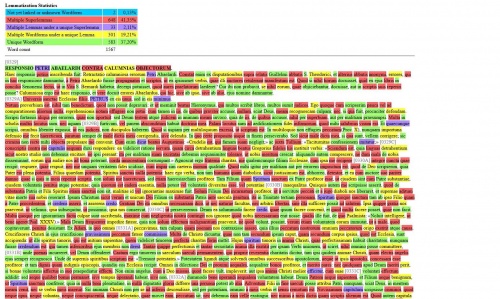
This is a lemmatization of a Latin piece. Such visualization allows readers to gain not only a better understanding of the piece, but also to gain new insights and questions. Crane ends with this note: “Our history now lies with the larger story of computing and academia in the twenty-first century.” Perhaps Classicists today are not just learning digital tools to simply increase the chances of their employability, but are simply part of a new transition.
Citations:
A Companion to Digital Humanities, ed. Susan Schreibman, Ray Siemens, John Unsworth. Oxford: Blackwell, 2004.
http://www.digitalhumanities.org/companion/
From Scroll to Codex. http://courses.educ.ubc.ca/etec540/July03/batchelorj/researchtopic/. Image. Web. 25 October 14
Disambiguation and Lemmatisation of Automatically Computed Texts. http://wiki.hudesktop.hucompute.org/index.php/Lemmatisation/Disambiguation. 14 October 2014. Image. Web. 25 October 14