Digital Harlem

For this week’s blog post, I looked at Digital Harlem, a map that purports to give a vision of everyday life in Harlem between 1915 and 1930. To do this, it uses legal records, newspapers, and other sources to place different events on a map of Harlem. Some of the mapped events are innocuous ones, such as basketball games, church services, dances, parties, and the like, but crime holds a prime position in the user interface- Alongside fields such as “Type of Event”, “Birthplace of Participant(s)”, “Race”, “Gender”, or “Street / Intersection Name”, there is a drop-down field specifically for “Charge / Conviction”.

This is a vision of Harlem with crime at its center, which is extremely problematic for a map that claims to be a portrayal of “everyday life”. While there are ways in which this is a defensible position, there are a few problems. Law enforcement has historically been (and continues to be) brutal towards people of color- which can not be ignored in a historically Black neighborhood. It’s easy to take legal records as an objective measure of the number of crimes committed, or the extent to which a neighborhood might be deemed “dangerous”, and harder to historicize them in the context of the type of biases held by law enforcement during this period. In the “sources” section, it does attempt to clarify that most of the DA’s closed case files deal with ordinary indivduals who were “usually acting out of desperation or poverty”, but it’s not nearly so visible as the map itself, and many visitors will not read this. Moreover, it also becomes extremely fraught to put “Charge / Conviction” as a single drop-down box. The baseline for a charge is much lower than that for a conviction, and this makes each incident ambiguous along those lines, which can heighten the image of Harlem as a violent, or crime-ridden neighborhood, which reflects stereotypes of what a Black community is.

I’m not sure how to reclaim this; the strength of data visualization is that it communicates immediately, on a visual, pre-linguistic level. However, it’s at the level of language that it becomes (somewhat) easier to add nuance, since we can articulate specific moments or ideas and make them available for criticism and deconstruction. If we have to reduce an individual’s entire story to a single record of a robbery, there’s simply no space to explore any of the ambiguities or external factors besides those sanctioned by the state. This is why theory is important; rather than replacing the map, or reworking the map, it can be useful to rethink the map that is already there.
Gender Breakdown of City Workers by Department

The datatypes available in the gender breakdown of city workers by department consist of year, department title, number of employees, numbers and percentage of male and female employees, their total salaries and averages, divided by gender, and a breakdown of the percentage of the payroll that was paid out to each.

The dataset’s ontology is a primarily gendered one, with an economically oriented epistemology, as it looks primarily at earnings and participation in the workforce, and uses gender to draw divisions within each department. It can function in a few different ways, but the clear overarching purpose is one of examining the role of gender in the workplace. Feminists, particularly, will find useful information here.

As far as the phenomenon described by the dataset, there are a couple of interesting points. Within many departments, more of the total payroll is distributed to women, but it’s only in Recreation and Parks that women actually show a higher average earning than men, and by a margin of less than $1000. This means that, in many cases, greater numbers of women are working than men, but that they tend to earn less on an individual basis.

As far as what’s left out, the dataset does insist on a binary categorization of male/female, which makes it incapable of accounting for intersex, genderqueer, and transgender identities, and the ways that those might affect one’s workplace participation and earnings. Studying this would require an ontology capable of accounting for a spectrum of identities rather than a binary.

Finding Aid for the Collection of Material about Japanese American Internment, 1929-1956 bulk 1942-1946


In this collection, the primary source of data is material from the War Relocation Authority, a government agency that advocated for Japanese American “internment, resettlement, and enlistment in the armed forces…”, which can immediately be identified as an institution that is/was invested in maintaining narratives of Japanese internment as being justified. As such, those particular sources are likely to minimize, justify, or avoid discussing the losses and troubles of Japanese Americans who were interned.

However, it is somewhat assuaged by the other boxes, which include information from the perspective of Japanese American individuals who were interned, or who served in the military. These cover some issues such as facing racism in the armed forces, the anti-Japanese sentiment of the time, troubles with reintegration into their previous communities, and conditions within the camps themselves.

There are certain potential problems with these accounts as well. While not unilaterally so, there is a culture of shame and silence surrounding Japanese American internment, characterized by the phrase “shikata ga nai”, roughly translating to “there’s nothing to be done”. Values in the Japanese American community often privilege silence and a determined acceptance of unfair conditions, rather than advocacy or an attempt to raise complaints. There are many narratives from individuals whose parents or grandparents continue to refuse to even talk about the experience, let alone attempt to remedy them.

This presents a unique challenge to researchers in that, in many ways, neither party wishes to actually confront the facts of what happened in the Japanese American Internment Camps, and it would require deep, complex ties and sensitivity to the community to adequately understand and shape this narrative.

cubism and abstract art

Inventing Abstraction is a project that attempts to document some of the origins of modernist abstraction between 1910 and 1925.

The dataset that they’re using for this project imagines 1912 as a radical break from tradition, and forms data around this thesis, naming Kandinsky, Kupka, Picabia, and Delaunay as the people who “presented the first abstract pictures to the public”, which then circulate through figures such as Duchamp, Mondrian, and Malevich. To do so, it uses images of the artists’ works, information about birth and death, birthplace, regions where the artist was active, information about which artists/writers that they encountered, and a couple of ideas that they may have been associated with, or taken inspiration from. (largely, white men)

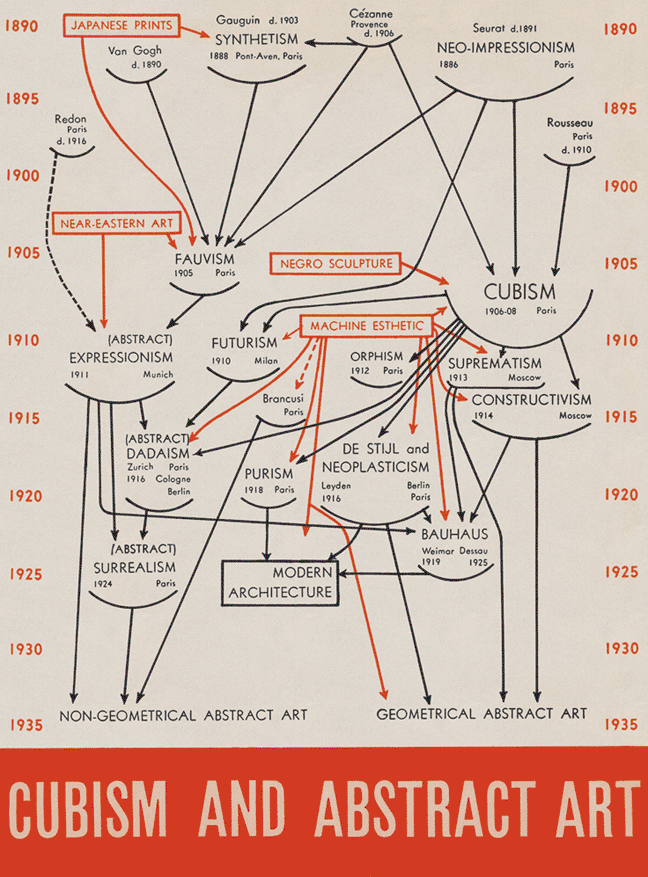
In terms of how the information is presented, the visual design of the site owes a lot to Alfred Barr’s curatorial/design work from a 1936 exhibition of cubism and abstract art.

The designers of the Inventing Abstraction page clearly use the same color palette, typeface and general strategy of linking together nodes, but they make the key change of eschewing the teleological tendencies in Barr’s chart.

Rather than flowing from past to present, from “less sophisticated” to more, it presents a rhizomatic network of relations. In doing so, it doesn’t make a key mistake of Barr’s chart, which creates hierarchies and flattens the contributions of people of color into single nodes that are only relevant as originary sources for modern (western) art. (note the total non-specificity of “Japanese Prints”, “Negro Sculpture”, or “Near-Eastern Art”- as if they weren’t hugely diverse bodies with competing schools of thought.)  By contrast, Inventing Abstraction does away with the use of arrows, and settles on lines as a less loaded signifier of connections. It also uses specific names instead of attempting to produce a single moment out of an entire ethnically-associated tradition, and has the decency to be specific about its date range.

As far as the interaction itself, it’s a well-designed thing. clicking on a node produces a name, works, birthplace, location, and interests, and maps a direct network of related individuals. The information tends to be somewhat narrow, but probably encompasses most of what a layperson would want to have immediately available.