Week 7-Network in “Scavengers”

This week I read a story titled “Scavengers” and visualized the network among the characters in the story. Told in a first-person narrative, the story is about an American tourist in North Korea investigating the true identities of a wrestler named Ryokdosan who had been celebrated as a national hero by North Koreans after Ryokdosan’s death on 8 December 1963. However, according to the source, the narrative found more reliable, Ryokdosan was a wrestler born in 1924 in some place which only became territory of North Korea after the war. His whole career was based in the Japanese-occupied Korea and in the US and he did not care about being patriotic for North Korea. His accidental death was also not political at all. The story reveals how distorted the North Korean propaganda could be.

With Google Fusion Tables, I am able to create a graph of important characters’ network as below. I define the “connection” is constituted by any interaction between characters or mentioning of one character by another. I focus on major characters so minor characters and collective characters are dismissed in the visualization because minor characters are only functional while the relationships related to collective characters were not specific enough. Another reason could be network among the collective characters could be symptomized by that of the major characters.

screen3


I first found this network graph illuminates the temporality about the characters’ connections. The graph shows clearly the stories had two storylines cored by the narrator and Ryokdosan respectively. Apparently the narrator’s story points to present. He stayed in the hotel North Korea prepared for foreigners after 1995. One rice wine bottle emblazoned with the Japanese pro wrestler Rikidōzan, known as Ryokdosan in North Korea in a gift shop triggered his interest in knowing more about this historical figure. Then he did his own research on Ryokdosan later. Then there came Ryokdosan’s story line that covered his whole life from 1920s-1960s. Within this story there is another story in 1995 when North Korea reinforced the story of Ryokdosan by inviting American wrestlers to fight against Ryokdosan’s protégé. Three different focal characters show how the characters establish their relations and how a false historical narrative built over the time.

Then I could see how the international connections could happen through the interactions of characters. The major characters travelled around the countries and seemingly they did as they pleased. However, North Korea, Japan and the US were the three nationwide forces dominating people’s activities in the stories. Characters’ actions are all built within the historical contexts manifested by the regulations and by international politics. At the same time, it is difficult to define which nationality Ryokdosan identified himself with even though in the plots both Japanese and Korean believe he should be exclusively Japanese or Korean. Ryokdosan connected all the three groups of people coming from those countries.

The graph is also helpful in addressing other questions like how people of different social hierarchies built influences and how knowledge and ideologies were transmitted throw traveling and narrating. It highlights the hidden relationship behind the elusive prose narrative. However, it cannot replace the narrative because of its highly reductive nature. The graph does not show motivations, temporal changes or character development. We need more supplimentary information like the original texts or critical works in order to understand this graph in a more profound way.
Week 6-Mapping decadence

I chose to analyze “Mapping Decadence: Visualizing Relationships Between Writers and Publishers” due to its relevance to my major of literature. This set of five digital visualizations investigates the correlation between four authors’ residences and locations of the publishers of the decadence genre in the end of the 19th century in Paris. With the digital tool of ArcGIS, although the author attempted to present certain objective connection between the two data types, her view was somehow pre-determined by her assumptions of the topic.

First, the author believed the spatial factor determined the interactions between the authors and publishers. That is to say, there is interdependence between the physical proximities of the authors of decadence literature and of the publishers who were prone to publish decadence literature. If this assumption was true, the authors had to often communicate with the editors face to face. Visits to the publishers needed to become part of the authors’ routine life. On the other hand, it may indicate that the publishers published based on the distance from the authors. The closer to the authors the more likely the authors’ works would get published. So validity of this assumption depends on the deficiency of public transportation/postal service and on the frequency of intimate interactions between the authors and editors. However, this may not be necessarily true. There could be other reasons to influence the locations of those two parties. For example, perhaps the authors decided to live in the neighborhood for economic reasons or convenience rather than considering the distance to the publishers.

The visualizations also select a unidirectional visualization to reveal the connection between the authors and publishers. The maps only geocode the four authors’ locations in relation to the locations of their preferred publishers but did not show all the authors who the publishers chose to publish. It is possible that the publishers also published works by authors writing decadency literature who lived far from the locations of the publishers or by authors in the provincial areas.

Moreover, she assumes the authors’ and publishers’ locations were static over the years in Paris. On the maps, we could see that one author could have several locations while one publisher only stayed in one dot. There is no timeline for the changed locations even though I assume the various locations of the authors could mean they moved over the time. Fortunately, on the “About” page, there was a link to her presentation on this project in a conference. She acknowledged the problem of chronological limitations and probably she will address it in her future research. “Photogrammar” the data visualization I analyzed in Week One is a contrast which relatively successfully combined timeline and geocoding.

The maker also expects viewers understand the background of the decadence movement in French literature because the website did not offer much information of the statuses of those writers and publishers in the Decadence Movement. A viewer would hope to get more knowledge of the authors or the publishers presented in the maps. The makers’ interpretation of the maps and her intentions with the mapping should also be revealed through more textual explanations. So far it is still only the visual part of her dissertation project rather than inclusively contains all aspects of her dissertation.

This mapping project came from a scholar who was preoccupied to prove the interdependence of the locations of authors and publishers from the perspective of the authors. It reveals the four authors’ one possible motivation of choosing residences, namely the proximity with the locations of the publishers. But it obscured many other factors that could cause the correlations of those locations such as economic considerations, cultural atmospheres etc. it also ignored one important factor in the literary market, namely the readers. How could the works inspire a literary movement after publishing without the locations of the readers?

An alternative mapping could be made after the makers define to what extent the proximity to the publishers determined the locations of the four authors and how the publishers made decisions on publishing. The maker also needs to make a timeline. I would add two more bar charters to explain the authors’ and the publishers’ statuses in the Decadence Movement. One is to explain the four authors’ statuses in terms of their works’ quality and quantity. The other is to list all the publishers who published decadency literature at the time and compare them with the publishers who published the four authors’ works. The locations of markets of this literature could also be mapped.

Week 4-visualizing death rates

This week I chose the dataset of death rates in the US for visualization and analyses because it offers statistic evidence to a unique topic, the culture of death in the US. The original data types were categorized by state. One data record includes several common causes of deaths and some related demographic information. First several reasons for deaths are crucial illnesses such as heart, cancer, stroke and respiration. Then there are deaths by other diseases including diabetes, alzheim, flu, nephritis, and aids. Then the spreadsheet shows the deaths by external forces such as suicide, homicide, accidents, etc. Although the original data are relatively clean a few data were marked as “null.” There are other problems with the original dataset too. Some data which are supposed to be whole numbers but they appear decimal. Also we don’t know which year or years those data were collected. Without any footnotes or other types of additional interpretations, we can only assume those data within the dataset represent information from the same historical periods and form certain comparable relationships among themselves.

deathrate-1

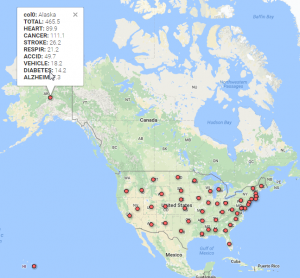
My first visualization was to geocode the data with Google fusion. The fifty states follow the alphabetical order in the spreadsheet so it was easy to notice Alaska but difficult to see data from Wyoming. We need to adjust the display to read a whole record too since it is rather long. For researchers, they usually need information from one or only a few states. This map uses dots to show the states within the same space. It breaks the original restriction of ordering in the original spreadsheet and offers all the record at once. To read a whole record one only need to point the mouse to the dot representing the state he or she intends to do research on. In this way, the map reorganizes the data and saves the researchers’ time.

deathrate2

 
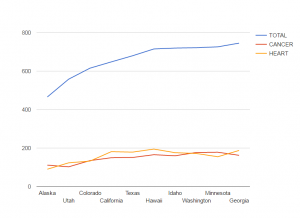
Then I visualize the comparisons of total deaths, deaths caused by cancers and by heart diseases between the ten states. Due to the large quantity of the deaths caused by cancers and heart diseases in any record in the spreadsheet is clear that cancers and heart diseases are two cruelest killers for humans in the States. But we do not really know the percentages of those deaths in the total deaths or comparisons between those biggest killers in the ten states because the spreadsheet cannot contain all the calculated information. This chart shows that generally speaking, neither cancers nor heart diseases constitutes even one third of the deaths in those states. So there are many other deaths responsible for the perishing of human lives. For some states like, Alaska and Minnesota, there are more people who died of cancers than of heart diseases. But for the states such as California, more people of heart diseases died. This chart is very useful in terms of studying how different public policies or local living habits in different states play a role in determining people’s deaths.

deathrate-3

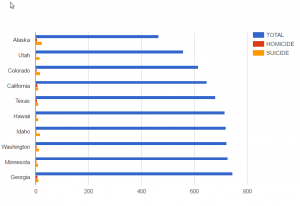
This third chart shows the ratios of total deaths, homicides, suicides in the same ten states. Because the original excel does not offer the percentage of any type of deaths in the total deaths, it is difficult to know how the data manifest different death cultures in different states. This bar chart at least shows how human’s willpower shapes different deaths in the chosen states. For example, Alaska has less total population than the other ten states but the bar of the total suicides is longer than that of any other nine state. It could indicate that Alaska people are more likely to feel depressed or desperate perhaps because of the financial difficulties, harsh weather or long nights in winter. The total population of Hawaii and Idaho don’t differ much but people in Idaho are more likely to commit suicides. For most of the states in the chart, the ratio of suicides to homicides is high but only in California and Georgia homicides and suicides are almost of the same length. So in those two states, the law enforcement should pay more attention to crimes to protect our safety.

Week 3-Dataset “Payroll by Department”

I found Payroll by Department (aka All City Departments by Payroll) for Los Angeles in the year 2015 quite interesting.  When you first click its icon from the homepage, the dataset is in a chart form mainly indicating proportion of every department’s payment in the total state government payment while if you choose “view it as a table,” “view it as a rich list” or “view it as a single row” you will see the chart is a visualization of a tabular data. A record in this dataset includes department title, year, job class title, projected annual salary, payments by quarter, payments over base pay, percentage over base pay and total payments.

Wallack and Srinivasan define ontologies as “systems of categories and their interrelations by which groups order and manage information about the people, places, things, and events around them.”[1] According to those two scholars ontologies reflect register different elements and their interrelation with each other in groups.  In this dataset, government employees’ salaries are first categorized by the different employer departments. And then those subsections are divided into four by quarter. At last, the projected salaries are compared to actual expenditures in one department.

It seems that this dataset is most useful for government sections related to finance and human resource such as “Economic and Workforce Development Department” and “Personnel” to track the payroll. They can detect any quarterly anomaly within one department in 2015 or investigate the discrepancies between salary budget and actual expenditure to make better plans for the future. Because of the bird-eye view this dataset offers, the upper-level government management agencies such as the mayor would also benefit from this dataset to understand how different departments work financially.

The dataset dedicated to express the differences of the payments among departments, reveals to me that the city invested greatly in legal enforcement, basic supplies and fire prevention due to the prominent payments to LAPD, DWP and LAFD. Those departments also pertain to more job class titles and more percentages over base pay. It could be an indication that jobs in those departments were more specialized, demanding or dangerous. Meanwhile, most departments worked most in the third quarter and lest in the last quarter, which suggests the city were very busy in the summer and more relaxed in the winter. The outstanding percentage over base pay in Employee Relations Board also caught my attention. I would like to know more about why this department had so few job class titles but the workers in the department seemingly worked extra hard.

This dataset seems less meaningful for an employee who considers joining in the government service. He or she cannot find out which position pays more in which department or how high his or her salary could be if he or she can get to the top of the department. He cannot even find the median of salaries in one department. Due to the different natures of tasks in different departments, it is hard to compare which job in which department is more rewarding.  The existing data also need more interpretation: why did the government spent so much on law enforcement? Compared to the dataset documenting the same ontologies such as the one from last year or the one from New York City of 2015, did LA spend less or more?

If I was to design a new ontology, I would add the percentage of increased payment for every department to show the yearly change. Decision makers may need the information. Also I would list the numbers of employers, the highest and lowest salary in one department to show how the expenditure was distributed in one department to inform those who consider joining in. It may not be a bad idea to merge this tabular data with “Payroll by Position” which offers a more micro-level perspective.

[1] Jessica Seddon Wallack and Ramesh Srinivasan. “Local-Global: Reconciling Mismatched Ontologies in Development Information Systems.” Proceedings of the 42nd Hawaii International Conference on System Sciences – 2009.

Week 2-On the Finding Aid about Japanese American Internment

I select the Collection of Material about Japanese American Internment, 1929-1956 bulk 1942-1946 for its significance in reflecting the history of Japan–United States relations. This collection includes primary source in the forms of publications, press releases, yearbooks, pamphlets, speeches, clippings of published articles, masters’ theses, artistic sketches, etc.  With an emphasis on the Manzanar and Minidoka internment camps, those materials, mainly documented the history of Japanese Americans, relocation, and internment during 1942-1946. And they were originally created by U.S. Department of the Interior War Relocation Authority (WRA) and by Japanese American internees and advocacy groups.

The materials have been organized and categorized into five boxes of different themes: two boxes for War Relocation Authority from 1942-1946, one box for internment camps from 1942-1945 and one box for miscellaneous from 1929-1956. The fifth box contains a poster recruiting to build a new Tokyo. If the first two boxes tell a narrative on the policies, social opinions and propaganda from the perspective of the government, the third box from the internment narrates the life of the internment from the internees’ perspective and the last miscellaneous box supplements the former two narratives.

This collection first tells us how the government planned, controlled, and inspected the internment camps with their quarterly and semi-annual reports.  It took the government some time to choose the locations for the internment and gather the statistics of the employees’ and internees’ life within internment camps.  Besides segregating the Japanese Americans, the camps attempted to mobilize, educate, convert and entertain the internees. Special attention had been paid to riots and violence in the camps. Those reports ended in 1946 with the closure of the Tule Lake relocation center.

The collection also demonstrates how the high officials updated their political opinions and explained the policies of relocating and resettling the Japanese Americans during the course of war. On the one hand, the government realized there had been riots within the camps and anti-Japanese American sentiments over the States. On the other hand, from the speeches, they also took pains to regulate Japanese Americans and ease their discontent. Positive examples such as Ben Kuroki had been set to show many Japanese-Americans’ loyalty to the U.S.

How the young Japanese-Americans grew up during and after the relocation formed anther narrative. Yearbooks from high schools in the relocating areas and all kinds of reports on “Nisei,” namely the second generation Japanese-Americans, portrayed a growing group announcing a disconnection from the older generations, their fusion into the American society and loyalty to the U.S. Meanwhile, the materials mentioned the racist prejudice that Japanese-Americans experienced during this period.

After reading the finding aid, I think the “Issei,” namely the first generation Japanese immigrants, were largely ignored. Perhaps because the awkward political and social position they were situating in during this period their stories and opinions were not included in the documents by the government or local institutions. To remedy this lacking, we need personal memoirs, pictures and oral history from individual first generation Japanese-Americans.  Materials from Japan on the issues of relocating and resettling Japanese-Americans may also deserve a position in the collection.

There are many other mysteries that had not been solved by this archive. What was the background of the donors Ralph P. Merritt and Bradford Smith? Were they employees of the government so they had access to the governmental documents? Or did they have a strong interest in the internment so they keep collecting all the relevant materials over the years? Why did they donate this collection to UCLA? To answer those questions, a clearer “Provenance/Source of Acquisition” could be written which could include a brief introduction to the donors and to the historical period where they gathered the sources.

Week One assignment-Photogrammar

I chose to reverse engineer the Photogrammar, a database created by a team of seven digital humanities at Yale University. This website employs multiple digital techniques to reorganize, visualize and analyze the photography collection by several unit photographers to document the political, economic and social life in the U.S. from 1935-1946.

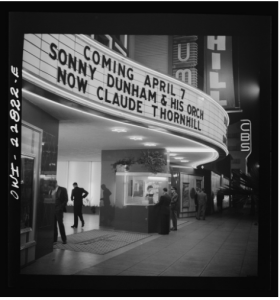
The 170,000 photographs, also collectively known as “The File” or “the FSA-OWI File”, displays the realistic moments during the Great Depression and Second World War in the States in order to support for and justify government programs. From sign and ticket window of a large dance palace in Hollywood (See Photo 1) to Japanese immigrants in Los Angeles, from desert in Arizona to snow scenes in Boston, from political assemblies to children playing on the streets, more than ten thousand images of different subjects in those photographs offer a rich visual history in the U.S. during the chaotic historical period. Originally created by United States Farm Security Administration and Office of War Information (FSA-OWI), the collection is now preserved in the Library of Congress. However, this online database offers a more accessible  and interactive approach for the public to view this historical source.


.photogrammar3_baoli

(Photo 1. Photo courtesy: Russell Lee, April 1942. Photogrammar. http://photogrammar.yale.edu/records/index.php?record=owi2001024138/PP. Accessed Oct 3, 2016)

To process the source, the digital humanists first scanned and digitized the photos.  Then they tagged and categorized the photos by location, by photographer and by date. Since the photo collections have been processed by Paul Vanderbilt from FSA-OWI with his “Lot Number System and Classification Tags System” in the 1940s before scholars at Yale developed the online database the website now incorporate and enrich Vanderbilt’s system when processing the data.

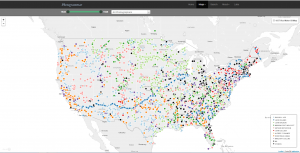
After describing the features of each photo the digital humanists geocoded approximately 90,000 photos on maps of the U.S. counties and made the maps reflect different photographers and changes of the historical period. As one core feature of the website, the map below is one of the maps that indicates different photographers’ routes and activities in different locations of different dates. (See Map 1)

Third, in the “Treemap” button of the “Photogrammer lab” section, photos are classified under different levels by subject matters while “Metadata Dashboard” button analyzes the correlation between date, county, photographer, and subject. Even though this dashboard only provides metadata for one individual state, namely California for now, its development is very promising in terms of examining how different factors participated in the project.


photogrammar2_baoli

(Map 1. Photogrammar, http://photogrammar.yale.edu/map/dots.php. Accessed 3 Oct., 2016.)

This database platform presents the processed the data in a user-friendly manner. Once you read the “About” and understand the purpose of the whole project a wide array of options in “Search” can easily navigate you to your desired contents. Themed by location and authorship, two different map options under the “Maps” button visualize and match the photos with the dates, locations and individual photographers. The homepage (See Homepage 1) also welcome random netizens to begin with the “start exploring” button to the map and to grasp the significance of the database with the three buttons at the lower part.

photogrammar1_baoli

(Homepage 1, Photogrammar. http://photogrammar.yale.edu/. Accessed by 3 Oct., 2016)

Supported by Leaflet and CartoDB, this database is a stimulating tool for audience especially scholars working in the field of U.S. political history, art history and media studies.