“First Semester”

After clicking on a variety of posts that merely only contained two characters in the short stories, I finally came across the short story, “First Semester” by Rachel B. Glaser and John Maradik, containing many characters. It’s interesting to see that this story was written by two people… I wonder how they interacted in their process to complete this creative task. I chose to make a list of all the characters that actually had direct and explicit interactions with one another. My “social network” is shown, having used Google Fusion Tables from my edge list, which contained multiple other columns of information, as well. I decided the direct interactions network graph looked most interesting, in comparison to sex, for example, because the other networks bunched together and were hard to read.

My network graph illuminates each main characters’ direct interactions, but it does not show how well one knows another person (or not). Sarah, our protagonist, is nicely shown in the center of the graph due to the story following her many interactions with family and friends. I did not include relationships expressed in the story that may have formed prior to the tale taking place, but were not explicitly shown through dialogue or personal interaction. I chose to do this because I wanted to maintain a sense of uniformity in the data, and I wanted the network graph to look a lot more like a “social network”… with its main characters at its center, and minor characters surrounding. These minor characters perhaps also act as foil characters to the main characters in the story. For example, the Dean and his wife remain in a binary, yet mutual, relationship, though they also may have had many direct interactions with each of the students in the larger section of the graph, due to his occupation. This was not explicitly stated in the story. My network graph does reflect how removed the main character is from David’s “Other Worlds Girl” – quite symbolic, if you are able to read the full story.

The network graph’s main limitation is that this graph does not show potential relationships with people prior to or after the story took place; these relationships could drastically alter the look of the social networks formed in this story. Also, it does not show how strong or weak each relationship is, such as “Random ‘What are you…’ Dude” (from a party) remaining in the same relationship strength as “Colin”, who Sarah forms an actual loving relationship with. Alternately, the color addition did not make much sense to true meaning of the network graph itself, either.

Overall, using Google Fusion Tables was not a difficult task, and I found that my data nicely formatted into the network graph format. This was mainly due to my finding of a story that had many characters in it… otherwise the network graph would have been binary and somewhat boring, aesthetically speaking.
Locating London’s Past

The DH mapping project I chose to investigate was Locating London’s Past, which allows users to locate various artifactual data, such as plague deaths and fire insurance, on John Rocque’s 1746 map of London. This project incorporates datasets from various different sources–mainly institutional (churches, hospitals, etc.)–to compare and contrast happenings throughout London’s history. The map uses Geocoder, which automatically matches and checks names of places on a map. The Museum of London Archaeology conducted this research product to be able to catch a glimpse of London’s historical data through georeferencing–slicing up the original map, warping it, and placing it on a more current understanding of the spherical globe. This feat is an act of obscuring the original data. Thus, the original map had to be altered and manipulated a little bit to relate it to the Museum’s narrative and understanding of London today. Then, one can compare Rocque’s map to the first accurate OS map of London (1869-80), interchangeable with a drop down menu on the home page.

In conjunction with Turnbull’s contention that all maps are perspectival and subjective, this map definitely reinforces those ideals. The Museum of London Archaeology has created a loose narrative, seemingly up to our interpretation, based on its multiple datasets. Unfortunately, the map itself makes it hard to display these multiple datasets on the one map at the same time without it being too messy-looking. Also, many of the datasets are “unable” to be mapped because of their lack of full information… the records given are blank spaces to be filled in with names/streets/etc. that must be researched (in the datasets themselves) or known before searching the dataset, in order for it to be later placed on the map. This openness may be interesting to someone from London with a long family history there, but leaves the newcomer without any previously-known records to input in these blank spaces. Therefore, the project assumes that the map-user is a scholar or researcher, or at the very least is well-versed in London’s archaeological history.

If I were to alter this map, I would give more options in searching datasets through a drop-down menu, instead of using blank spaces, in order to make the map easier to use for the naive user. The map reveals London’s archaeological past, but it obscures what can be found based on overly specific records–some of which are unable to be mapped because they have to match up with data found in the dataset. I think the georeferencing of the map is fine, but I was unable to fully map any of the datasets onto either of the maps due to my lack of knowledge of a person’s name matching up to a parish, for example. To alleviate this issue, I would make a pop-up window with the full dataset that the user can click on in order to find out how/where it could be mapped onto each map. The site luckily gives ample information on each of the datasets’ backgrounds and I wish this had been incorporated better into the map’s interface, since everything is on a separate page. Overall, the map is interesting, but I did not find out as much as I had wanted to due to my lack of knowledge of specific records–this is the main thing I would alter. Also, the webpage is quite bland in color and design, so I would also change these aspects to draw the users in more in order to help the user create a more specific narrative to follow.

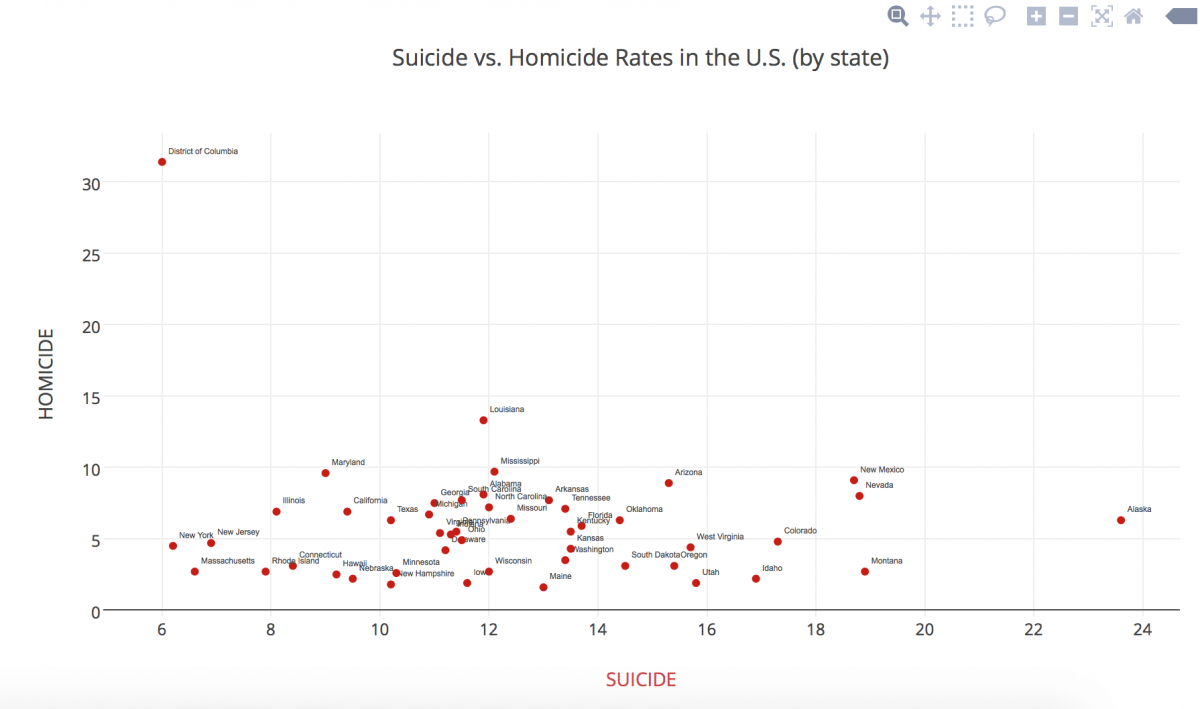
Week 5: Death Rates (Homicide vs. Suicide) in the U.S. (by state)

In this blog post, I actually let my roommate choose which data set I should use because I was interested to see what she would choose from such a wide range of subjects. Of course, she chose the “Death Data” data set… and I’m slightly scared of falling asleep tonight now….

For this data set, I initially tried using the Tableau Public data visualization tool, but the column that contained the states names (qualitative variables) did not even show up. So, I went back into the Excel document and added a title to the column itself in hopes of better setting up the data in Tableau… to no avail. I then tried opening up the data in the RAW website, which did not accept the data into regular code for some reason. It had changed colors even and it looked like the data was not properly being transferred over, so that obviously didn’t work. I also tried opening up Google Fusion Tables, but neither Safari nor Chrome was allowing me to open it up… there seemed to be an issue with public/private access.

FINALLY, I tried using Plot.ly, which consumed the data set beautifully! After playing around with different types of graphs, I settled on the scatterplot, mainly because it was the best way to show multiple types of deaths at the same time, especially being able to show individual states’ differences. I then played around with shape and color, something Nathan Yau mentions in his article as pertinent.

My graph shows a simpler visual distinction of how each state overlaps in death rates, crossing homicide rates and suicide rates. It is interesting to see the outliers in a visual manner. I noticed a positive trend in my data (excluding the outliers) as a result of the visual representation.

*Unfortunately I am unable to embed the link to my data set or visualization into this post because I need to pay for an upgrade to be able to share it, since I used “pro” features. Sorry!


Library Items Circulated 2006-2015 (Week 4)

The dataset I chose to work with is “Library Items Circulated 2006-2015,” which is a data visualization in a graphical form of the number of library items circulated, which is based on the “CAFR 2015 Operating Indicators And Capital Assets For Dataviz.” It indicates the text and numbers associated, separated by year, and shown in a final line graph (this constitutes records in this dataset); the number value of each year corresponds to the number of library items circulated, though this unfortunately does not identify what those library items may consist of… this seems to be of a great loss to understanding fully what each library circulates. The values/records range from about 14-16 million. I would have liked to see further insight into what kinds of books are circulated more or less each year.

Using Wallack and Srinivasan’s definition of “ontology,” it is simple to identify that this dataset’s ontology comprises of factual data from the database of the LA Controller’s Office, using their policies, which are not necessarily explicitly mentioned in this dataset. Perhaps the ontology, means of data collection based on values, of the LA Controller’s Office was merely to collect the data in a fair and correct manner, whatever that may have meant to them… Srinivasan in particular uses an organic means of data collection, and aims to collect data from the community members it affects the most. Considering this dataset has to do with library archiving, I would assume that archivists or librarians would benefit the most from this dataset. Perhaps also politicians, policymakers, or unionists may find this data the most useful and illuminating due to being able to allocate funds accurately and fairly to the city’s library workers.

This dataset tells us that though the number of library items took a dip from 2010 to 2013, it looks as though library item circulation is increasing in more recent years, giving me hope that literacy and fact-finding is still being promoted throughout the city and its academic sources. I wonder what kinds of articles, books, textbooks, or archives are included in each year’s circulation. These facts are what is left out the most by this limited data set.

From a grade school teacher’s perspective, I would promote an ontology for this dataset that includes records such as genres collected, and by whom. I would like to know what ages of children are drawn to certain types of books or novels, or other media, and I would perhaps implement this into my school curriculum, to promote reading and high literacy levels. The ontology would include a more specific dataset, as to better understand how the city of Los Angeles could also better include certain types of books for certain age groups and locales in the process of teaching and socialization.

Finding Aid for the George Meyer Simpsons script files

The finding aid that I chose was of the George Meyer Simpsons script files, as this show is one of my all-time favorites. The collection contains 313 notes, drafts, or scripts from the infamous television show The Simpsons, from 1990-2004, which were either written by or altered by (through annotation or some other form of writing) by George Meyer. These also include censor notes and character design sheets in the artifacts. It is important to note that George Meyer is not the sole writer in this series of documents, though these artifacts span his career with the Simpsons show.

A pertinent historical narrative that I would be able to tell through this collection is how George Meyer’s life or career is reflected through the episodes of The Simpsons. Oftentimes, television comedy writers tend to draw from their own experiences to find material that an audience may be able to relate to. Perhaps there are certain narratives from his own family/friend life that are also seen in elements of The Simpsons, such as through funny characters or through certain scenarios. This can be done by comparing his biography in the finding aid with some of the content in the artifacts. This can be done chronologically over time, as both the writer and the scripts develop simultaneously.

Aspects that would be missing in my narrative would include a large range of family/friend situations that are not mentioned in his biography. Perhaps this can be remedied through an interview of his personal history and its influence on his career. Alternately, interviews with his fellow writers, family, or other significant people in his career, such as other credited writers in this collection (Al Jean, Mike Scully, John Swartzwelder, and Jon Vitti) may be able to allow us to fill in the gaps on this particular narrative. Perhaps also there may be certain scripts, notes, or drawings that are missing from this collection that may have acted as Meyer’s starting point and influences for future scenes or characters in episodes. Also, certain drafts or suggestions may have not actually ended up in the final script for each episode, since so much editing goes in to each episode, especially depending on the time frame and censorship laws at the time.

Overall, I found this collection to be extremely interesting because many narratives could be drawn from this extensive collection. I would have liked to see it divided up more into the type of document/artifact it was, but perhaps this may happen with the data at a later date through narration…

MoMA’s “Inventing Abstraction”

The project I chose to explore was the Museum of Modern Art’s “Inventing Abstraction” (1910-1925) because my mother is an abstract artist, as well, and it is interesting to be able to take a look into the beginnings of the abstract art world. Growing up, I was always dragged around to museums to view artwork without being able to appreciate the art because I did not understand its historical or cultural significance. However, this website may aid in being a bridge for younger and more digitally-minded patrons of art museums because this interactive website exhibits abstract art from the period of 1910 to 1925, and many of these works can be found in the New York City Museum of Modern Art today. This website also exhibits abstract artworks from across many various media platforms–from poetry to dance, and from painters to photographers… Abstract art is both an artistic movement as it is a historical and theoretical rejection of narrative subject matter in artworks that had become so commonplace to artists and patrons of the past. I began searching through this website on its title page, which fittingly displayed an abstract painting in the background of some text that described the background and purpose of the art movement’s website. I then clicked the “Explore Connections” button on the title page, and began sifting through the site from there.

It is clear through the primary diagram display on the “Connections” tab that the abstract art movement did not start from a singular source, but was much more networked over a period of time and in different locales across major cities in Europe and the Americas. The diagram display is interactive, and shows just how interconnected each artist was to a group of at least four or five other artists. Once one clicks on one of the artists named, it will bring them to another page, where the artist selected is of main focus, seen in the featured image of this post. The site then organizes and exhibits the artist, the years he was alive, his birthplace, places worked, and artistic interests, which all contribute to the images of works he or she produced. One may even click on the works provided, and be linked to another web page that displays the image in a larger format, and gives information such as the year it was produced, the title, and a description about the work. While this is a great way to exhibit the collaboration between artist networks and later show individual progress in the abstract world, I did not appreciate how certain artists (such as Kandinsky) had long paragraph-form descriptions about them in this section, while others had none. Although this may not have been avoided due to lack of information given to the museum, I think the museum could have done a better job at creating a more streamlined view of each artist’s background. An example of this is how prolific and influential artists such as Georgia O’Keeffe did not contain long text descriptions on their artist page, despite their importance to the abstract art movement.

On the “Artists” tab, all of the artists presented are organized in alphabetical order by last name, and clicking onto an artist’s name will bring them back to the same artist’s diagram page, as previously discussed. Again, some artists have their names highlighted in orange, while most of them do not. Those with orange highlights seem to be important actors in the abstract world’s initiation and foundation because long paragraphs are written about them in the white space provided below the “Interests” category. Though this can be easily deduced, I wish it had been explicitly noted why the orange highlighted names were presented in such a manner, for those who may not be so technologically savvy. It also bothered me that certain players’ “Interests” sections, such as Max Weber’s, were left blank, when clearly he had many artistic interests that influenced his career and the movement itself.

I thoroughly enjoyed the “Conversations” tab, which displayed videos mainly of artists speaking about important abstract artists and their works from this period. Abstraction can truly be an interactive process, despite its variation in medium. The videos are informative and a more personal way to examine information to be learned from this exhibit. However, I did have trouble playing a couple of the videos, and I am not sure on what end this may have been a problem from…

Finally, the “Programs and Events” page displays upcoming events at the MoMA that relate to these abstract artists described in the movement, whether it be through an exhibition or a dance performance. This page includes images of the work, text about the artist and the work itself, and hyperlinks to purchase the tickets, and/or the artist’s website. Everything is categorized by event in a clear manner due to color. Overall, this page allows the digitally interactive website to come to life with real events that people can interact at and discuss more of the works. While I liked the abstract display of the title page a lot, I wish the rest of the site’s page used colors and background displays that perhaps reflected the work of the artist themselves, as the title page did.