Early African American Film is a digital humanities project created by students at UCLA. The group constructed a database on African-American silent race films that focused on films created before 1930 for African-American audiences. It contained information including films, actors, and production companies and how they all are connected. Since this topic is seldom discussed, I enjoyed exploring this project and learning about film history.
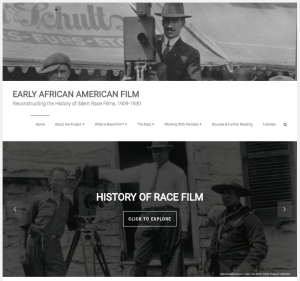
Sources
The workgroup gathered information from many primary and secondary sources. One major archive used was the George P. Johnson Negro Film Collection, which can be found at UCLA’s Young E. Research Library with items such as documents and newspaper clippings related to early Black films, companies, casts, and notable figures. Another major archive was the Mayme Clayton Library and Museum, which contains collections such as manuscripts, rare books, film and recorded sound archives, photographs, and much more that document race films. An example of a secondary source used for this project is a collection of essays that examine the work of Oscar Micheaux, an influential African-American filmmaker, and the relationship his race films had with the black press. A full list of sources used can be found here.
Processes
A database of information was created and presented as a spreadsheet, hosted by Airtable. The data could be sorted many different ways–by people, films, companies, and sources. Clicking on a data entry would give you information such as their full name, relevant notes, films appeared in, films worked on, sources, associated production companies, and more. The data could also be filtered and grouped for the user’s ease. Also, a glossary and many different tutorials on how to build graphs, maps, and other data visualizations were included to help users familiarize themselves with the information and to encourage users to engage with the data.
Presentations
This project presented the data in a way that allowed users to not just look at the data, but also modify and use the data. The site is very interactive and presented information in various ways.
On one page, there was a histogram (created by plot.ly) of when films were being produced, and users could highlight certain areas to zoom in on a certain area to study.

There was also a network graph that visually connected people and films. If you double clicked on a data point, it would reveal people they were connected to by working on films together. The network graph included all of the people in the database associated with films, such as actors, directors, producers, cinematographers, and others. It gave context into who the larger people were and what the larger networks were.

To help visualize production companies, the project included a time map (created by Carto) of the location of African-American production companies throughout the year, which gave more insight on the trends of race film production.

The ways in which the data was presented visually helps users explore African-American race films in many different contexts.