Inventing abstraction is an interactive website site based on MOMA’s 2013 exhibition that explores the trajectory of abstraction through modern art. The site consists of information on artists influential to the movement spanning from 1910-1925. With the information provided audiences are able to construct comparisons of participating artists, and understand the movement itself as an agglomeration of changing ideas that originally sought to undermine and challenge concepts related to how we construct and understand imagery.
Much of the Site’s source material is derived from the exhibition itself, as well as the exhibit catalogue, featuring in-depth information about the artists included within the show. The site also features videos and audio samples of contemporary artists speaking about specific works within the show and curatorial director Leah Dickerman explaining her intentions as they relate to the contextual history of abstraction.
Leah Dickerman’s main argument within the show is to emphasize the interconnectivity of artists involved within the movement, to dispel to the idea that abstraction was contrived in a space of isolation. The main bulk of the website supports this claim as it visually shows how many artists were in dialogue with one another.
In order to process this material, Dickerman sat down with her team of researchers and placed all of the artists in a Microsoft Excel spread sheet. From there, they would go through each artist and see if they were acquaintances of or in dialogue with any of the other artists within the list. They would then draw a line connecting the artists, quickly creating a complex web of interconnectivity.
The information is presented with an interactive map that allows the user to click on each individual artist to view who they had been in dialogue with. Artists who appear to be connected to a severe degree are labeled with a red font.
Vasily Kandinsky being the ‘most connected’, much of which can be attributed to his published works and the circulation of these writings. As the user clicks on each artists a new page appears that allows a more centralized and specific account of interconnectivity.
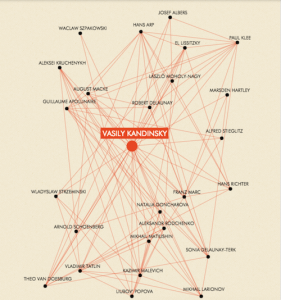
As well as this complex web, the site lists each artist individually in alphabetical order, when a name is clicked on it will provide the web that displays the contextual role that each artist played within the movement, listing the work exhibited within MoMa’s exhibition as well as where they worked and art historical movements that they were invested in.
The website itself allows a helpful visual argument to Dickerman’s main point, which suggests abstraction evolved as a conversation and experimentation among artists within the early 19th century. The interactive quality allows the user to engage within this experience. However, the site does not seem to specify exactly what constituted as ‘being connected’ with another artist as it can be assumed that some artists may have been more direct dialogue than others. Regardless, the website is able to paint a comprehensive picture of the complex evolution of abstraction.
Dear Booger,
I’m impressed at the depth in which you tie in art history and conceptual backgrounds to your understanding of the data.
I also applaud you for critically examining the rubric by which artists were assumed to have connections with one another – it is left up to the visitor’s imagination, which may undermine the point of the exhibition, which is to elucidate and carefully document the processes by which an art movement began. Without any explicit knowledge of the control variable for this research, the quality and significance of each artist’s network of colleagues falls under question.