 Partly because of midterms, and partly because of my previous blog post where
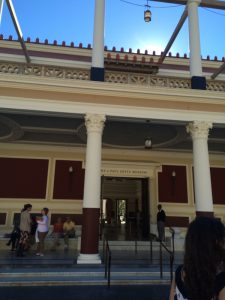
I began to discuss the use of technology in exhibition, I chose to revisit/resume my usual haunt of the Getty Villa.
During my observations, most patrons chose to ignore the available terminals (GettyGuide Stations), instead reading some of the wall text and captions, if anything at all. Most of the time is spent looking at the artifacts – making comments based on observation or feeling, a personal connection to the past, rather than an accurate one. And this is fine, considering the thematic approach to arrangement, which suggests a comparative focus (life then vs now)
There are a few exceptions to the technology use, however. The first, is of course the movie provided at the beginning and near the entrance to the villa. Many days, like this one, there was a short line of visitors waiting to see it in allotted groups. This is not surprising, considering the unusual setting. How and why the Getty Villa came to be (in its replication of the Roman Villa of the Papyri) is a common question and curiosity. Having taken classes there for several quarters, the novelty of it has faded some, though my love for the Roman domus overshadows all else. That said, I prefer the garden.
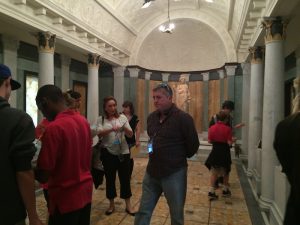 The second exception is the audio tour, which was more utilized than I realized, though perhaps limited to those who visit the museum on their own or who had a special interest in learning more about the artifacts than what was written. Those on this tour spent less time reading and more time examining what was being described and explained to them. I wonder if these are the same set of people using the terminals in the special exhibits (upstairs) about [Fayum portraits on] mummies, Roman glass, and mosaics. Mummies are, of course, an archaeological “fan-favorite,” so this may be an unfair assumption. And the videos lining the corridor between the mosaic rooms failed to capture the attention of most visitors for more than a minute.
One room of difference is that dedicated to outlining a fuller chronological view of the collection. I found this room crowded by visitors of all ages, scrolling through text on the terminals – matching it to the full-room timeline and illustrative pieces (artifacts and fragments thereof), which explains where and how these objects are found. I do think this contributed to the decision to rearrange the exhibitions into a more chronological fashion, and I wonder how much more of the archaeological facts will be installed into the new exhibitions. Though it is curiously not my story, many children dream about being an archaeologist when they’re young (though this is usually directed at dinosaurs – paleontology, or some sort of Indiana Jones fantasy), and this type of information caters to that sense of imagination. The same kind exhibited by many visitors at the archaeological sites themselves.
The last room I want to mention is “the Family Forum.” Most of the attention in this room goes to decorating the white-board style amphora, though a large portion of the room is dedicated to a screen. This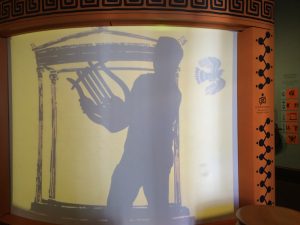 room is designed with young visitors in mind, though it does not escape me that many of the drawings on the amphora are quite sophisticated. Still, the screen was not used in the time I spent there, and only with a little goading did I manage to convince a friend to choose one of the preset scenes and grab props for a photo.
As we spoke about it in class, a part of me wonders if the disregard for the technology at the villa has anything to do with the atmosphere. Despite the additions of family-friendly rooms, the main exhibitions still maintain that somewhat cold, paintings-on-a-wall atmosphere – that you need to know something about the cultures in order to appreciate it “properly,” and maybe some visitors feel alienated, or judged, if they spend too much time reading/watching? I hope this is not the case, but discussions with my family (when dragging them somewhat unwillingly to museums) has led them to admit that their lack of college or engagement with the subject is embarrassing somehow. And my protest is always culminated with the single response: that’s why it’s there – it’s displayed for visitors to learn about the art/culture/etc, though what is “taken away” from the experience is, in the end, up to the visitor.
I am interested in your hypothesis that visitors feel a sense of embarrassment in needing to read or watch explanatory media. As you said, this feeling might be a result of feeling like there is a “right” and “wrong” way to understand the works. Perhaps the fact that many of the artifacts on display at the Getty Villa are ancient makes people feel intimidated when trying to understand the history? In other words, perhaps contemporary works are more approachable because they might represent a socio-historical period more easily understood by the viewer?