I visited the Hammer Museum this week seeking to observe and understand how they chose to use technology in their exhibitions. For the most part, there was a distinct lack of technology, and most exhibits were focused on the objects and displayed them in a more traditional way – backed on tall, white walls with pieces of tape on the ground warning visitors to keep their distance. I found only two exhibits which implemented technology. The first was Jimmie Durham’s At the Center of the World exhibit, which featured a few mounted screens which played a five and a half hour long documentary by Durham. This was an interesting addition, because it was simultaneously an educational tool that gave some further backstory about the art, and it was art itself. While watching it, I found it to be a bit of a challenge to wrestle with these two differing goals, which felt as though they were in opposition.
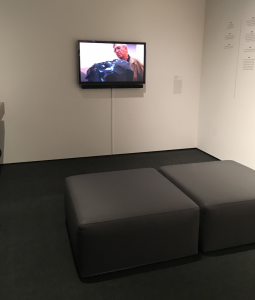
They chose to display this video in a walled-off corner of the exhibit, which I found to be a fascinating example of the traditional museum complex. The fact that this area was sectioned off from the rest of the exhibit showed that the technology was considered separate from the physical art, and the screen was essentially hidden from the outside. There we a couple cushioned seats, but only a couple other people wandered into the video area, and they tended to stand and watch for only a minute or two before leaving. Perhaps the fact that the video was so many hours long demotivated people from watching because they knew they would not be able see the entire thing.
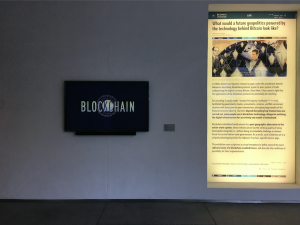
Another exhibit by artist Simon Denny featured a similar screen outside its entrance. The project was exploring the possibilities of blockchain technology, which is the system which underlies the digital bitcoin currency, and I was somewhat shocked that the only digital aspect to it was an explanatory video. That being said, I thoroughly enjoyed the video, which was only about four minutes long and featured well-designed animations and clearly explained the concepts behind blockchain. This technology was not there explicitly to be art, yet it complemented the exhibit and enhanced the overall experience by giving me a better understanding of the art. In this case, the video was playing in an open courtyard area, and although many more people passed by, they generally did not stay and watch through the whole video. Interestingly, in both cases the exhibition designs in the Hammer did not lead successfully lead patrons to fully use the technology. Perhaps the contrast between the physical art objects and the digital meant that visitors did not consider the videos as an actual part of the exhibit, and therefore did not appreciate them as such.
I really enjoyed your post. I personally have been wanting to head over and see Simon Denny’s work, based on its description on the Hammer website. It is really interesting to hear that no technology is used as a medium in his work, but that it is more of a conceptual motivator and central subject matter. He has taken the technology out of representing tech, and focused on the networking and exchange involved in bitcoin market.
I also found your description of the documentary video installation for the Jimmie Durham exhibition intriguing. The choice to show a film that long in an exhibition space offers a completely different experience of documentary film than is typical. The expectation is that the visitor will not stay for the entire film, nor are you to experience the work in its entirety. I wonder if they offered a special screening of it as part of the additional exhibition programming. Thanks for sharing your experience!