This weekend I visited the art gallery Sprüth Magers in LA’s Miracle Mile, where they were hosting an installation by Montréal artist Jon Rafman. Rafman’s work delves into the odd, and often abject realms of the Internet, dissecting how sub-cultures are formed and psychologically manifested. His work is manifested in the technological, and aims to find different ways of engaging art through emerging technologies.
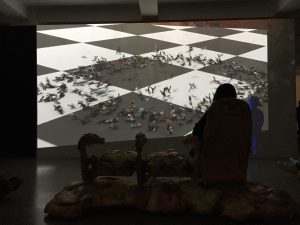
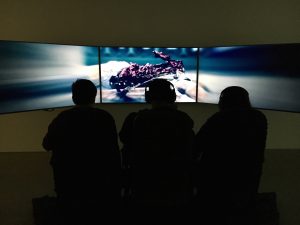
The gallery had three separate pieces, the first called Poor Magic (2016), is a video projection of different computer generated crowd simulations. The CGI characters run into walls and get swept up by pendulums, moving together with uncanny and rather silly mechanics. The whole experience is made even more uncomfortable as Rafman designed grotesque benches for viewers to sit on while watching the film. The chairs look as though they are made of strange, alien flesh – making the experience all the more alienating. By making these chairs, Rafman seems to replicate the sense of being a spectator in a movie theater, yet tweaks it, making this seemingly familiar act foreign. Another piece, Open Heart Warrior (2016) uses three video screens to surround the viewer with lush and graphic video game imagery. As this video seemed more traditional and static, I noticed less people taking the time to sit and view its full-length.
In the final piece, Transdimensional Serpent (2016), one gets to wear an Oculus Rift to experience a Virtual Reality art space. I waited with others in a line to get to try out the VR, something I don’t think I’ve ever had to do in a museum setting. But once it was my turn, I was fully immersed in the VR environment. The video itself depicted several different “transdimensional” environments, and turned the bench I was sitting on into a large white serpent eating its own tail. The video very playfully messed with my sense of space; in one instance figures approaching me grew to much larger proportions than expected. The use of VR technology in an art gallery created a new kind of intimacy, that at once built a space unto myself and took me out of the space I previously inhabited. While this was a particularly art-minded space, it led me to think about how VR would be used in another museum setting. I believe the technology does not lend itself to realistic spaces, but rather succeeds in placing someone in a surreal or absurd environment not previously possible.


The idea of VR in museums is so intriguing to me. Like you mentioned, it really plays with your sense of space and transports you into another landscape and time completely. For me, thinking about VR brings me back to landscape panoramas of the 18th century that excited people in a way they had never experienced before. Panoramas were a main form of entertainment and became an attraction themselves, outside of museum and gallery space. Painters like Thomas and William Daniell immersed viewers in multi-sensory experiences and allowed one to be an eyewitness rather than a spectator. In a sense, it was like VR without modern technology, but relying on the technology of the construction and materials of the painting to present an accurate landscape. Your post has me wondering how and if artists/museums will continue to utilize VR – will they continue to use it to present this other-worldly, surreal experience? It seems like with the advancement of technology, there is this simultaneous nostalgia for the past, which has me feeling like the panoramania type of realistic landscapes could reappear.
In another class member’s blog post, he mentioned that visitors tended to engage with artworks for much longer when they were wearing a headset. I like your blog post about the use of VR in a museum setting, it seems like in this day and age people are seriously attracted to the new technology and take any opportunity to try it out. While VR isn’t practical to guide visitors around a museum, I think augmented reality has the potential to be extremely cool to use in a museum setting. Instead of a visitor wearing a headset and listening to audio to be guided through the museum, it would be interesting to incorporate augmented reality to to the guiding instead. For example, wall labels for art pieces are usually painted onto the wall next to the piece. With AR, the labels could be expanded to tell more about the artist or the period of style. Alternatively, you could be able to pull up contrasting artists works to be viewed next to the original to compare styles or techniques. To come to think of it, the possibilities for the use of AR in museums is extensive.
It is interesting how Rafman approaches art. It seems that he wants to offer art as an experience, more than simply visual stimuli. I think the idea of interacting with art as a tool for engagement, rather the focal point of mere observation is quite different from the traditional perception of art. VR experiences definitely provide great platforms for this, but at the same time, though it is a very personal experience, this also makes it very isolating. Often, art is consumed in a communal space, where you not only interact with the objects, but also with other visitors, observing their reactions. It should also be noted that VR experiences can cause up to 60% of the neurons in our brain to stop firing, according to Professor Mehta’s research at UCLA. I truly wonder about the potential for extended VR experiences, if that is the case, and the possible effects. I wish that there were less issues, including motion sickness, such that experiences are less contained in purely models in a limited space, and branched out to greater expanses of exploration.