For this blog post I visited the Getty. The first major use of technology I found while walking around was in the context of the “Bouchardon: Royal Artist of the Enlightenment” exhibition. Edmé Bouchardon was the Royal Artist of King Louis XV and was famous for his sculptures, drawings, and coin engraving. The exhibit, which is on loan from the Louvre, starts by featuring several busts he carved (pictured below) as well as many of his chalk drawings. The next room features one of his most famous statues “Cupid Fashioning a Bow out of the Club of Hercules” and then a few of his engraved coins. The last room features several prints and sketches he made of ordinary people as well as a wall-sized sketch of his last project, an equestrian statue of Louis XV, which he was working on before he died in 1762.

Within the first few rooms there is no technology incorporated into the exhibit. However, in the last room there were two touch screen monitors on stands. The first monitor displayed the text “Tap to start” and then once tapped the screen had a little blurb about Bouchardon’s sketches. From there you could scroll through and enlarge about fifty other sketches that were not featured in the exhibit. The second monitor also displayed the text “Tap to Start” and then played a five minute video detailing the construction of the equestrian statue of Louis XV. While I was walking around this room I noticed that most people did not pay much attention to the touch screen monitors. Most people just walked past them and looked at the art on the walls. I observed a few people who did stop to look at the first monitor but most just tapped the screen once, read the little blurb, and then moved on. I only saw one person stop and look long enough to seem like they were actually scrolling through all of the pictures. I didn’t see anyone actually stop and watch the equestrian statue video beside myself (and I didn’t actually watch all of the video either).
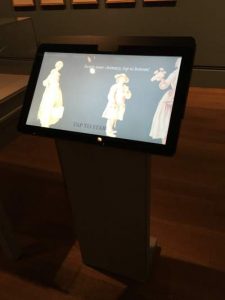
While I understand the logic of including technology in this exhibit, I don’t personally think it belonged there. Given that the other visitors didn’t spend much time using the technology either I feel like they had similar sentiments. The whole exhibit gave off the vibe that one was just supposed to observe the physical objects that were present and not look at them through the lens of technology whether that be a monitor that was actually included in the exhibit or your own cell phone. I say this because I asked a security guard whether I could take photos so I could use them for this blog post and he said I could in the first room but could not do so in the other rooms. While I realize that this could partially be because the museum doesn’t want un-copyrighted photographs going around the internet, I also feel that this particular exhibit was better experienced in an un-mediated manner. Therefore, I feel like the exhibit could have completely done without the second monitor. Furthermore, while I understand that digitizing some of Bouchardon’s sketches allowed there to be more present in the exhibit, I still think that visitors did not get as much out of the digital copies as they did the real ones on the walls.
I think that you are definitely describing a sort of exhibitionary complex, in which you and the other patrons were aware of what was expected of you in this art museum space. I feel like for me I would’ve been excited by the opportunity to be interactive with the museum, but I think I might be a unique case. I appreciate you sharing this!