For my second site visit, I chose the Hammer Museum because I’ve never been there ever since I started going to UCLA. Although the Hammer Museum is affiliated with UCLA, it is not located within the campus but nearby Wilshire boulevard which makes it fairly accessible compared to other museums. Plus, the free admission was the best part. When I walked into the courtyard of the Hammer Museum, I was greeted by this beautifully designed lamps hanging outdoor which resembled the Chinese lantern festivals. Soon, I was able to meet the famous Spun Chairs that I’ve only heard of. I was glad that they had plenty of the chairs because people were reading books in there. Well, I didn’t hesitate to try one myself. It felt really awkward at first and was I had a hard time spinning it like other people did. But once I got the hang of it, oh boy, I felt like I could sit there all day. It was amazing to see how it managed to maintain the balance, maybe this could be part of a technology? As I was leaving the Spun chairs behind, for some reason, I thought of the totem of Leonardo Dicaprio from my all time favorite movie Inception. Well, If I ever get to spin this giant totem upright, it would take less than three seconds before I know whether if I’m caught in the Limbo or in reality.
The exhibit I took the time to look at was a video exhibit in the At the Center of the World Collection b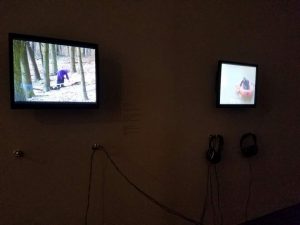 y Jimmie Durham. There were total of six separate screens fixed to the wall and each screen had two sets of headphones under it to prevent collisions of sound. Although the room wasn’t packed, all the headphones were occupied when I first walked into the room. I decided utilized that time to observe how people were interacting with the exhibit. The amount of time watching the video varied by people, some easily got bored and moved on to other ones quickly while others seemed to be interested enough to spend 5 minutes for each video. Some viewers didn’t bother to put the headphones on, with their arms folded. There were written texts next to each screens that people barely paid attention to. I think it’s because the room was really dark and there was no illumination other than the dim lights coming from the screens. After a while, I was finally able to secure a spot
in the corner. I noticed that while the screens and the headphones were high quality, the video itself wasn’t. In terms of the contents of the video, I honestly could not understand what the creator tried to convey because they were so random, which I think is the wonder of the art because it really provokes your thought where you can come up with your own interpretations of it.
To be honest, I enjoyed the Spun chairs more than I did on the videos but overall, I was really glad that I visited the Hammer Museum before my graduation and am grateful to this class for offering the chance I would not have if it wasn’t for this class.
I loved how you brought up the point of accessibility and how that may impact the patron. I believe that perhaps the museum’s free admission and it being easily located, not only draws people in, but creates a greater feeling of exploration. In addition, it was interesting how they decided to include wall text in such a dim setting. It seems, based on the quality of the videos and the layout, that the museum is struggling to integrate technology in a seamless and valuable way. I’ve noticed that many museums share have this issue and it makes you wonder how exactly a museum can constructively cope with continuously advancing technology.
It sounds like it was the artist’s piece itself that was utilizing technology in the form of audio/video, not necessarily the museum, so I think that needs to be taken into consideration in the critique. However, it is weird to me that they would bother having wall text if they did not plan on having the room well lit.
I went to the same exhibit, the videos to me actually did speak to his art’s meaning. They all demonstrate native art in a way that is told though his perspective of having self exiled himself from the country in order to get a new perspective. But I do agree that for a lot of people they seemed to be pretty random. However, it was still a good use of technology in the modern museum.