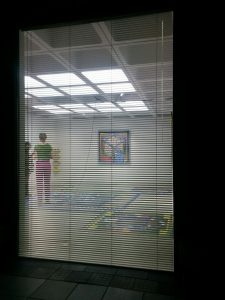
Echo and I went to see an exhibition by Brenna Murphy, a contemporary new media artist who works with VR and contemporary manufacturing processes as part of her artwork.
Her work was exhibited at And/Or Gallery, which was a small office space that reminded me of a dental office. Inside of the space, there were multiple prints and constructions made of a combination of plastic, glass, and metal. The centerpiece of the work was a VR headset, though there was audio playing in the space on 4 speakers that was audible to everyone.
There were few visitors to the exhibit, as it was a relatively small, relatively obscure one. People engaged relatively evenly with all of the artwork, but were always clearly waiting to try the VR headset. Inside of the VR exhibition, Murphy presented a space that was formed in relation to the physical objects that she had created, with some of the same patterns and structures, such that while wearing the headset, one would see some of the same objects in the same places, but surrounded by a different environment, thus presenting a type of AR through her VR installation.
It was kind of fascinating to start to see conventions for VR artworks being established- At the Jon Rafman show at Spruth Magers, for instance, there was a bench to sit on that correlated with an object that was presented in the VR experience, and there was an individual there to provide assistance and supervision for viewers. The same format of having a gallery attendant handing the user’s experience with VR and matching objects in the physical space with the virtual space occurred at And/Or, and I began to think about the ways that the latter facilitates the transition between reality and virtual reality, and perhaps alleviates some of the clunkiness of having to figure out the mechanics of the VR headset.
I kind of have a sense that virtual reality isn’t quite developed enough to stand as a proper aesthetic ground yet. Much of the draw of the virtual reality experience is that it is still a rare one. Many of the people who seek out such experiences are likely interested primarily in having a virtual reality experience rather than the things that are contained within it- Though this may change after they’ve engaged with the work, the fact is that there is not yet a canon of VR work or an established basis for evaluating or building some kind of relationship with the artist’s specific decisions about how to use the technology.
Because of this, virtual reality becomes an object in itself, rather than a neutral ground to stage experiences. As immersive as it may be, it is impossible to ignore the fact that it is on a screen, or that it involves a headset- A person wearing the headset becomes part of the exhibit, for better or for worse. Rafman handled this by creating a space where this would not be out of place- one enmeshed in technology and gamer/geek culture, such that VR headsets seem fitting for the space. Murphy, though, does the opposite. Rather than shape the space around the fact that a person will be in it, she shapes the exhibition context such that it serves as an immersive experience for the individual wearing the headset. The audio, the space, the sculptures contribute to the experience of the individual who is engaged with it, to create a more intimate space.
In fact, this may be partially due to the physical constraints of the galleries in which they were exhibiting work- Rafman had a large space to work with, and needed to deal with the challenges of a show which involved heavy foot traffic and people receiving everything inside as sculpture. Murphy, with a smaller space, was able to create a single immersive experience. As much as VR dematerializes an experience, it also seems to have been determined in large part by the notably low-tech physical boundaries of the space in which it exists.
The VR exhibition looks very interesting, I can imagine how attractive it was to the visitors. I have to agree with your point you made about having VR experience comes first than the content, mainly because most of us are not familiar with VR and it hasn’t been very long since it became known to people.
My aunt got me a VR headset for Christmas (one where you can just put your phone in and then have to download apps). While using it, I was mostly focused on trying to figure out how to use the apps and the virtual experience they were meant to represent and never though of them from an “art” perspective. Both of the exhibits you mentioned seem very interesting and I like the idea of treating VR as an artistic experience.
I would agree that at this point, people are still not as familiar with the VR experience, and may assign value to it at first, simply due to the novelty. This may be due to the barrier to introduction, mainly being cost, and the portability of such devices in their current form. I think it’s generally a difficult problem to map items in a physical space to a VR space, though it generally isn’t the point. I do like the idea that Murphy was trying to put layers of information on top of an otherwise mundane space.
I love that you compared the Rafman and Murphy exhibits; it’s interesting to read how they both incorporated VR in different ways- one artist created the exhibit around the individual blending with and becoming apart of the surroundings, while the other emphasized making an immersive environment. I really agree with your comment that VR is an up and coming tech that people are unfamiliar with and thus there’s a sense of excitement surrounding it. People are definitely more excited with having the VR experience than the content the experience actually entails. It will be really cool to see how more and more museums will start to incorporate VR into their exhibits as it is the turn of the century technology. The transition seems to already be starting and I feel like the high standard for VR in exhibits will slowly develop over time.
So awesome to hear about this! I think you are right that some of this will work out in time. Part of this is understanding if this is a medium that is part of a shared experience or not. Right now, the technology is still a bit expensive, so it makes sense to share it in public so many people can experience the VR work. However, as it becomes more affordable, I wonder how often this kind of work will be shared in a “gallery” space.