I spent some time in the Getty Center’s temporary exhibit, “Bouchardon: Royal Artist of the Enlightenment.” The exhibit was organized by roughly four large divided spaces, featuring my sculptures, sketches, painting, and coins. Not being very busy the day I went, visitors were able to roam around freely with lots of personal space.
The visitors walked at a slow pace, around the edges of the room. Many patrons would peruse a few items, and then stop to read the plaques of works that interested them. Although, I noticed that the majority of people spend a long time staring at the pieces; especially the sculptures. The large sculptures, which were commonly placed either in the center of the room or near an entry way to the next space, were popular points of interest.
As I looked around, I noticed how barren the space actually was. The entire place was dimly lit and the various materials on display were spread out a good distance apart. Thus, the small pieces like coins and sketchings were often passed over by the audience.
Largely, the space was dominated by the pieces themselves. The reading wall texts were mostly small and colored to almost blend into the walls. Throughout every room, except the last, there were no digital/technological elements.
At the very end, actually right next to the exit, they set up a medium-sized screen that played a looped video of how bronze statues were made using a mold. With no sound, moving diagrams/illustrations and floating text, were utilized.
What was so fascinating about this lone piece of technology was how the people flocked to it. Even with the museum not being very active the day I went, there were a lot of people crowded around the tiny screen. I could barely watch the video with so many people standing by. They even sort of fought for a spot in front as to easily watch it, so they didn’t have to resort to looking over peoples’ shoulders. The general energy around the media was one of fascination; people were almost hypnotized by it. Additionally, other people became interested when they noticed so many people crowded around the area.
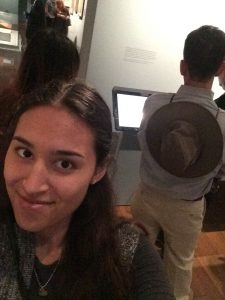
The technology probably had such an effect on the audience because it stood alone and was unique to the space. In fact, it seemed almost out of place to my eye. Thus, it certainly stuck out like a sore thumb.
While it was enjoyable and informative about bronze sculpture making, it was rather difficult to access it. I kept wondering how the visitors would have responded to the media if there had been many other videos posted throughout the exhibit. Perhaps, so much attention wouldn’t have been paid to just that one. Even more, maybe there would have been less interest in the videos altogether.
That the scarcity of the technology made it more effective is an interesting thought, though it does sound like the accessibility could be frustrating. Was the curiosity of it increased by the fact that people had to crowd around it? Sounds like a social experiment. Did the video supplement/add to the exhibit or did it just present the information in a different way?
The idea of a technological piece in the museum as a social experiment is fascinating! Honestly, I would love to see a whole exhibit designed around that idea. It could actually be something incorporated into our own project this quarter–displaying the same information in a couple of formats, but dressed up differently, to see where people originally become the most engaged when certain variables are changed.