For this blog post I decided to visit the Hammer Museum in Westwood and see what technology was applied to the exhibits. The first instance of technology I saw was a tv screen outside of the gallery hosting Simon Denny’s exhibit. It showed video on loop that talked about block chains in order to give some context about the exhibit inside the gallery. Most people seemed to stop and look at the video for a minute or two, and then continue on into the exhibit. Given that block chains are technology I was surprised at how little technology there was in the exhibit itself. There were large game boards and plaques on the wall describing the games but honestly I had no clue what was going on. I think many other people had similar experiences because people would walk into the exhibit, look around for a minute or two and walk out. They didn’t stand around and look at all the different pieces like they did in other galleries of the museum.

The only other exhibit that applied technology was “Jimmie Durham: At the Center of the World.” This exhibit mostly contained sculptures that Durham has created over the course of his career. However, one of the first things you hear when you walk in the exhibit is this incessant “pinging” noise. Turns out it is from a piece he called “Stoning the Refrigerator,” a 3:27 minute long video clip of Durham throwing rocks at a refrigerator. This noise adds to the feel of the exhibit as you can hear it from almost every point in the exhibition hall. I didn’t see many people examining this particular video which I found surprising given how annoying the sound was.
The main place for technology was in two alcoves that contained several video monitors. One room contained a large TV that had the sound on as well as a bench so an individual could just sit down and watch the film that was playing. The video was a five hour documentary style film that featured a couple different times of Durhams life. There were also three smaller screens with headphones attached that played other films featuring Durham. There was one person besides myself in the first room and she only stayed a few minutes while I was there. The second room contained seven video monitors that played videos Durham had created. I watched parts of the videos titled “Smashing,” where women placed objects on his desk and then he smashed them with a rock, and another video that I did not note the title of where he sang songs of his youth. The only person I saw in the room did not interact with the technology and seemed to be using the room as just a place to sit down for a moment.
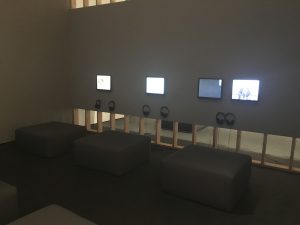
Overall, while technology was present in this exhibit, it did not play a central role. It came only in the form of videos that people didn’t seem to want to watch. Instead they observed his sculptures and seemed to spend more time actually reading the wall text. While I realize that Durham created these videos as pieces of art, I think his other works were more interesting and gave the viewer a better sense of who he was as an artist.
It’s surprising to me that there was such little interaction between the patrons and the technology- especially since the exhibits featured topics about technology or works that were actually digital media. Even more, people had more involvement with wall text and the physical pieces than anything else.
What I found during my own exhibit experience was that people flocked to the technology that was used. Differently, there was little use of technology so, it created this effect where the technology really stood out to the viewer. I further wondered, what would have been the reaction of patrons if there was greater use of technology in the exhibit? I hypothesized that maybe they would have interacted less with the technology, due to its prevalence.
While this seems backwards, I thought that the sole reason there was such a response to the tech in my exhibit was because of its minor position in the exhibit. This created such interest and made it shine.
In your exhibit, it appears that perhaps there is some validity to my hypothesis. Maybe because of how the tech elements were presented, it failed to attract viewers altogether?
It seems like most of the technology at this particular exhibit in the Hammer Museum were displayed as actual objects of art themselves, which strikes me as interesting – when I think of the use of technology in museums, I think of headsets and electronic devices that people check out and carry around as they tour the exhibits. It’s apparent that technology even as a central focus rather than an accompanying accessory to the art is neglected.