In January, I had the opportunity to apply technology within an exhibition context. A colleague from my department, Bernard Brown, presented solo and small ensemble dance works as part of the Fowler Out Loud performance series in conjunction with the Nkame exhibition. Bernard allowed me to film his performance in the museum space with my 360 capture video camera(s).
During the camera tests in the space prior to the show, the wandering visitors were definitely curious. Because the cameras are small and lightweight, they do not seem to produce the same response in people as a larger video camera rig would. Instead, people act more like they are being surveilled. The size and round shape of the camera itself seems to illicit a simultaneous uncomfortableness and curiosity. People want to look and not look because they do not want to be looked at. There is also a sense that it is an alien thing in a foreign space. If I stepped away from the camera rig, people seemed to be unsure if the structure was meant to be part of the exhibition or not or that they we playing a game of “which of these things is not like the other” and were unamused at how obvious it was. They would immediately look around for an explanation for why the camera was there or who had the responsibility for looking after it, as if it should not be left there on its own. Some even glanced at the wall labels and then back at the camera, to see if they would offer any reason to why it was there.
During the performance there was a malfunction with one of the cameras, so unfortunately, I only have footage from a stationary camera that was set in the center of the large room for three of the dances. Bernard’s first improvisational solo performance was in the small gallery hall when you enter the exhibition. While I do not have footage, it was incredible to see how Bernard interacted with both the artwork and the technology during his performance, which seemed to fuse the two for the audience. Bernard set his printed programs for the show in a circle on the floor around the 360 camera rig. It seemed to instantly turn the camera into an altar or shrine space and people knew not to crowd too close to it. At one point in his performance, Bernard moved to the ground and while we looking up to the artwork on the walls, he was position right below the camera, which seemed to elevate and incorporate its gaze into the performance. Needless to say, I’m very disappointed that this footage was lost.
The rest of the footage came be found here and should be played within a YouTube app or using YouTube 360, otherwise it will flatten out the image. As the audience moved into the center gallery for the performance, the second camera rig was hardly noticed at all, though you can see one young man smile at the camera as he walks past to find a seat on the ground in front. For the rest of the performance, the camera seems to fade away due to its small size and it offers us a view of both the dance performance, the exhibition space, and the audience’s reception.


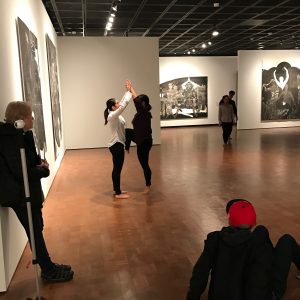


When the performance was over, people spread out into the space, as they discussed and shared praise for the performers, musician, and choreographer. I was making my way over to the camera when I realized that people were beginning to bump into it, and so I quickly had to grab it and make it through the crowd to take it apart in a less crowded space. Unlike the art that hung on the walls, the camera was not treated with reverence, despite its involvement in the performance and exhibition space.
This is such an interesting perspective and I thank you for sharing it! Most often when we talk about technology in relation to an exhibit, we talk about its immediate consumption by the patron; like viewing a finished video, etc. We seem to never talk about how the audience reacts to being part and taking part in its creation, particularly in the exhibit space itself.
It makes sense that there would be this feeling of being surveilled, but yet still feeling curious. Imagining myself in that position, I too probably would have been in search of some explanation to why the camera was there. I probably would have also been unsure of how I was supposed to react to it; look into it, stand far away from it? I wouldn’t have fully understood the camera’s place in the exhibit, thus not fully appreciating its contribution.
I wonder how these people reacted or would have reacted to watching the 360 video?
Awesome post!
I really liked your approach on assessing the general attitudes and interactions with the 360 camera, and what an opportunity to interact with the Fowler museum gallery space in such a way! I wonder if such behavior towards these types of cameras will evolve over time as this technology develops. You really get a sense of the space and its construction, even though the image is skewed in its own way, through distortion or technological limitations. I wonder how footage will be edited in new ways in the future, or if these cameras will begin to be more mobile and maneuverable.
Thanks for filming the live performance! To me, your post itself is essentially a piece of digital exhibition as well. I really appreciate the effort you put in recording the spacial features of it, and watching the video is definitely a unique experience.