Located in South Kensington in London, the Natural History Museum is one of the most beautiful buildings the city has to offer. I remember standing outside in awe as a child, then going inside and being further blown away by the range of exhibits the museum has to offer.
The museum is categorised into colour-coded zones: the Blue Zone exhibits past and present biodiversity – Dinosaurs, Fishes, Amphibians and Reptiles, Human Biology, Images of Nature, Mammals, Mammals (Blue whale), and Marine Invertebrates. The Green Zone exhibits the earth’s past and features Creepy Crawlies, Fossil Marine Reptiles, Fossils from Britain, Investigate, Birds, Minerals, and The Vault. The Red Zone takes a more physical approach to the nature of the earth and exhibits Earth Hall and Stegosaurus, Human Evolution, From the Beginning, Earth’s Treasury, Lasting Impressions, Restless Surface, and Volcanoes and Earthquakes. The Orange Zone exhibits the Darwin Center and the Wildlife Garden, and this zone takes a more interactive approach as guests are encouraged to observe ‘scientists at work’ or experience the garden from within.
All natural history museums are tasked with an incredibly challenging mission to categorise their collections and exhibits in a logical and related ways. Since the content of these museums is so widespread I would find it incredibly challenging to begin to have to think about how to create efficient categories. By the way London’s Natural History Museum categorises and lists its categories, it is clear that the target audiences children. Exhibits seem to group together in a way to educate children in a logical progression (for example, grouping physical geographic processes with tectonics and geology).
In a museum like this, with such a broad range of content, there are thousands of different permutations of alternative categorisation. I suppose the museum could have grouped all human processes together (biology, evolution) and all geological processes together (minerals, restless surface, volcanoes and earthquakes). What seems to be the prevailing variable is time – the museum groups exhibits together based on similar time frames, not similar subjects.
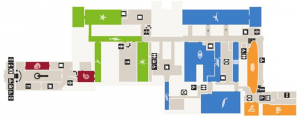
Organizing natural history can certainly be a challenge like you mentioned, but it seems like London’s Natural History Museum did an exceptional job of this. It’s obvious from just glancing at the map what you can expect to find in each section, and I really like how the individual exhibits are grouped together into more comprehensive sections which are color coded on the map. Especially when the target audience is children, it is key for museums to portray as clear and orderly a narrative as possible in order to best educate young visitors.
It was interesting to hear that the museum used color and time to organize its exhibits. I agree that it is definitely challenging to choose and implement one kind of organization method, given the massive amount of content they want to display and the extraordinary number of organizational choices. To me, it seems like the color coding of different sections is a straightforward and visually appealing way to categorize exhibits. By using these “color zones” to group objects, I think the museum did a better job of creating an interesting and fun learning experience for their targeted audience, the children (as you pointed out). It would be nice to hear from the organizers themselves about why they chose this particular method to organize and place the exhibitions– since there were so many other ways they could have completed the task!
From the way you described it, visiting the London’s Natural History Museum sounds like an exhilaratingly educational experience. It is very clear that this particular museum went above and beyond the standard methods of categorization to provide an exceptional display of their exhibitions. I like that you also mentioned how it caters to the target demographic of children; I think the color-coded sections are a great way to help children categorize thought processes by time frame and subject matter!
I actually want to visit the museum from reading your post, the dinosaurs and blue whale sound attractive. As you mentioned, categorizing the exhibits can definately be challenging and I think the museum has done a solid job of that in a simple and easily distinguishable way. I also liked your suggestion of categorizing exgibits based on similar time frames, it’d be really cool to see how all those organisms evolved throught the time.
Thanks for introducing this fascinating museum! Categorizing collections into colored sections is definitely more flexible than the traditional floor plans, and from your description I am able to understand the mission of the Natural History Museum. Since I haven’t been able to visit the museum myself, I wonder how do the curators arrange the objects within each of the zones: are they divided in a chronological order? or are they grouped according to their locations instead? As you have pointed out, organizing natural history is an extremely complicated task, and I agree with you that LNHM has an insightful categorization.
I appreciated this post a lot. The Natural History Museum in London is one of my favorite places in the world, courtesy of a traveling buddy who ended up working there as an administrator and who made sure we spent a lot of time going through the halls. Agreed that the map and grouping is there to facilitate the needs of children and also to create a deep tradition of educational space. There are other areas of the museum that are reserved for scholars and scientists but those areas lack the luster of the public spaces. The color coding makes sense for educational and organizational purposes alike. I understand your idea of sequencing items based upon composition, but wonder if something would have been lost without the emphasis on chronology?