The “Funds relating to Health, Environment and Sanitation” dataset collects information on government money made from various health and environment-related municipal services. Data types recorded include the Fund Name, Cash amount, Fund Purpose, Sources of Funds, Ending Fund Balance, Assets, Liabilities, Current Collected Revenue, Currently on Budget, and more. These data points make up a record that is distinctly aimed at recording each fund’s monetary information.
In “Local- Global: Reconciling Mismatched Ontologies in Development Information Systems”, Wallack and Srinivasan discuss how “ontologies represent reality, but this representation of information may in turn become the basis for actions that in turn shape reality…Any actor’s effectiveness in achieving their goal thus depends on the quality and completeness of their ontology” (3). Therefore, the success of any public policy is partially dependent on the “completeness” of a dataset on which the policy is based.
The “Health, Environment and Sanitation Funds” dataset has an ontology, in which its data is directed primarily at the monetary spending, sources and revenue for municipal services. For example, this dataset displays the astonishing amount associated with the “Solid Waste Resources Fund” – more than $200 million! As a result, this ontology makes the most sense to provide information for any city department in charge of keeping track of profits, expenses, and the movement of funds. This system is an effective way to follow where large amounts of money are being both spent and received.
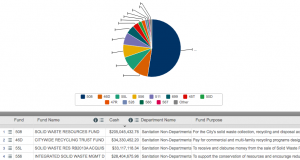 As Wallack and Srinivasan state, “States’ attempts to promote “development” are thus limited by the information loss between the community ontologies that define development and meta ontologies that guide their actions” (3). This “information loss” is a result of each dataset’s particular ontology, and how it may not be able to tell any other narrative than the one it was created for. This can be seen clearly in the ontology of the “Funds relating to Health, Environment and Sanitation”, and how it is directed at tracking government spending. The ontology of a dataset greatly influences the policies for which the dataset is being based on.
Since the fund highlights the money aspect of health and environmental services, it does leave out other data points. For example, this dataset does not take into account the success or customer satisfaction of the services. Projects for “street drainage improvement”, “Air Pollution Reduction Projects”, a “center to provide drug use education”, and more could be evaluated to see if actually made a difference in improving the city. This could be an example of a useful ontology from someone else’s point of view. For instance, an environmental organization would shift the emphasis from money to one of city betterment and improving the health of citizens. They would be interested in questions like, how was the city’s solid waste sorted to be as environmentally-friendly as possible? How much did the “Air Pollution Reduction Projects” actually reduce L.A. air pollution? These are examples of others questions that could be asked, and were not addressed in this dataset ontology.
Your dataset was extremely interesting! I remember looking at it and being wowed by the amount of money we spend on solid waste. Its absolutely extraordinary! I love that you included the point from the essay about how ontologies represent reality, but this representation of information may actually become the basis for the actions which lead to that reality. Because this ontology has such a huge amount of money going towards solid waste services, it may become the basis for the following years to budget more money towards solid waste services. However, this may not be the ideal choice- it may be more wise to invest in recycling efforts and other policies to reduce solid waste. However, because this ontology describes such a huge amount of money going toward solid waste, it may become the basis for future policies which may not actually be the best course of future action.