I had the opportunity to go to the Broad Museum in downtown and explore the plethora of modern art available there. As I searched for something that contained technological influences, I stumbled upon a piece that stood out to me initially based on its position in the gallery; suspended several feet above the air, emitting whirring noises from little fans and jets that spread over what appeared to be a military boat. The exhibit I am referring to is Chris Burden’s Bateau de Guerre. Upon a visit to Google translate, I learned that bateau de guerre literally translates to “warship” in French. The overall impression I got of the piece was a contrast between whimsy, brought in by colorful toy airplanes, and degradation, initiated by rusted fuel cans that served as the base of the boat. However, as I watched people interact with the exhibit, it was the technology behind the motion and lights and its general engineering that made people stop and examine longer than usual.
Visitors seemed particularly drawn to the engineering of the piece; many of the materials it was constructed from were extremely ordinary, and the technology employed was simplistic: LED lamps, little fans, etc. Perhaps it was the accessibility of the technology that made people seem comfortable observing it. I particularly have felt that technology can truly enhance the visitor experience by introducing a familiarity to a piece with a common ground most individuals interact with daily. This piece is no exception to that rule, except it takes it a step further by introducing technology that appears to be within the realms of an average person’s capabilities. Suddenly the piece is brought down to a more relatable level, and from that, the average viewer can seek to derive more meaning and individual interpretation from it. Furthermore, I felt that inclusion of toys and materials from children’s building sets provided a nostalgia to the piece that most visitors could relate to, and use to harken back to their childhood upon observation. This particular selection of technology provided an even greater connection between the viewer and the piece.
Ultimately, I felt like the piece drew people in with its impressive size and the sheer engineering and placement of Bateau de Guerre. What seemed to captured the viewer’s attention more than anything was the simplicity of material and accessibility of the style of the piece that maintained the viewer in ways that other pieces cannot. I rarely saw anyone study the text describing the piece, other than perhaps for clarification on the mediums used to construct it. This piece, in my opinion, speaks to the power of simple technology to elevate a piece in stature and intrigue, while also bringing the museum goer into the art by giving them something that can be broken down into completely comprehensible sections. Overall, this visit presented another opportunity to examine the role of technology in fostering attention-capturing art while simultaneously breaking barriers between viewer and artist. 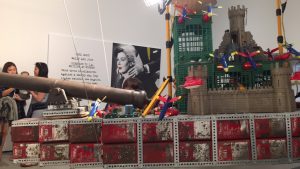
Do you think works of art that make use of technology are better suited to curatorial and interpretive techniques that use technology? In other words, perhaps art made by artists that are attuned to technology and incorporate technology into their work might work in concert with digital components in an exhibition and be more easily wed with technology like video or interactive iPads. Could you imagine digital interpretive content that might have worked with this work of art?