For my site visit report 2, I decided to go to the Museum of Tolerance and see the Anne Frank section of the museum. It was absolutely unique from all the other museums I’ve visited in my life. When you first enter, you are received by someone welcoming you to the museum and guides you at every corner of the museum. You begin your tour by watching a short video on a projection screen which briefly introduces Anne Frank’s story and puts things in context. Then it is followed by another short video on a screen behind you which begins shortly after the first video finishes. Televisions and short video technology is used extensively throughout the museum. These short videos are typically 3-5 minutes on various sized TV screens along the narrow hallway complimented by several physical exhibits including hand written letters between Anne Frank and her friends and family. The screens and exhibits are on the right side of the hallway while folded clothes of, I’m assuming, Anne Frank’s and her family. In its entirety, the tour is about an hour and fifteen minutes. This museum is unique because it is guided by a recorded narrative coming from small speakers as you walk down the hallway. You are listening to Anne Frank tell her story as you look at the exhibits and artifacts pertaining to whatever is being talked about. This put the exhibits in context and allowed you to fully immerse yourself in the exhibits and Anne’s story.
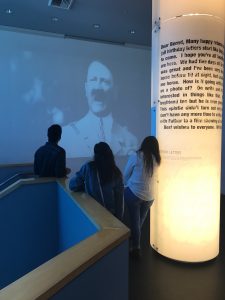
The above picture is of visitors watching the initial video.
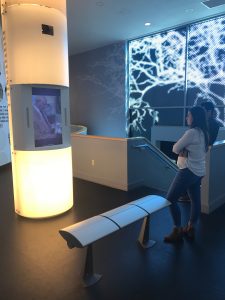
The picture above shows the visitors turning around to watch second video.
The visitors have to interact with the technology, otherwise, they may not necessarily know what they’re looking at. All the visitors basically walked together from screen to screen listening to the audio tour. You have to wait for Anne’s narration to begin from the next speaker to step forward and look at the exhibits under the speaker. This is a very organized way of using technology to share a story and have people follow along which helps to understand and retain the exhibits. At the end of the tour, there are screens where you touch a leaf and it ask for feedback on how the museum made you feel. Some of the options were “sad”, “inspired”, etc. Visitors basically paid attention to all of the elements which includes the videos and exhibits. It’s kind of designed in a way that you have to otherwise you will fall behind. The elements of the exhibit that people ignored were probably pictures on the walls when you first walk in but for the most part, everyone kind of followed along the audio tour. Since it is so organized and narrated, the visitors followed along and spent sufficient time reading wall texts as well as looking at artifacts. I definitely enjoyed this museum and would like to go see the general section of it as well.
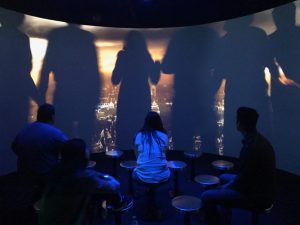
The picture above shows visitors watching the story of Anne Frank narrated by her in a room that is surrounded by screens bringing her story to life by providing images. This video was probably the longest.
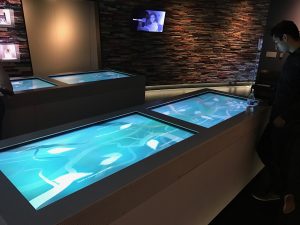
This picture above shows visitors providing feedback on these touch screens.
This sounds like a really unique experience. I think the guidance throughout the museum is helpful and allows the visitor to be more deeply informed about the topic. Sometimes I skip some of the art descriptions in museums and regret not grasping the full affect of the art. But this scenario makes it more difficult to miss any aspects that the museum is trying to portray. I think it’s an exceptional usage of technology and really pulls the visitors in for a truly engaging experience.
The recorded narrative following visitors seems like a good idea because it’s a lot easier to multi-task with the video screens and audio than the written texts and the audio/video screen. I liked how they arranged an entire section to tell a life story of someone. Reading your post got me looking back on my life and I wish that at the end of the day, my life will be worthy enough to be part of a museum like Anne.
I’ve always wanted to go to the Museum of Tolerance; it sounds like it was a really memorable experience. I really like how this museum contrasts/compliments the physicality of Anne’s letters and personal artifacts of the past with the modern technology of the present. The marriage of the two seems to me as if it’s meant to remind visitors of how we have so many resources allowing us to remember and memorialize these important events in history.
For this type of exhibit, the technology they chose to use worked very well. Since Anne Frank’s life is like a timeline, using videos one after another makes sense (as opposed to another exhibit of many different artifacts or paintings, where the time periods could have some overlap). I think it is a very well thought out experience to give the visitors. However, I do wonder if the successive videos limit the visitors in a way- where their experience is entirely mapped out for them (you said that they “have to interact with the technology, otherwise, they may not necessarily know what they’re looking at….[and how all] the visitors basically walked together from screen to screen listening to the audio tour”). While the technology does a great job “immersing” the viewer, I wonder if it limits their own discovery of what the museum has on display.