For my second visit, I went to the Hammer Museum which has a reputation for some to the weirdest and interesting exhibits in the Westwood area, so I assumed they would have some exhibits that were heavy on technology. Though they had many different exhibits present in the museum, they were surprisingly lighter on the interactive technology side. However, I found an exhibit called Jamie Durham: At the Center of the World that utilized video in order to better convey the meaning of the exhibition and it nicely complemented the art that was there which made for an all in all more interesting and deeper experience.
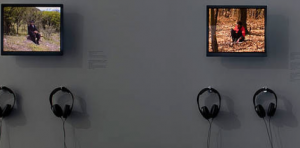
Essentially, it was just a simple set up with three ottomans in front of smaller TV screens. Each screen had a different video that explained backgrounds of Native America, specifically how it relates to the author and how the artist has been effected by his upbringing which eventually drove him to create his art and other works. The videos that i watch explain the cherokee culture and how they adapted to the presence of settlers, in addition to what the tribe is continuing today and how they have taken on the geopolitics of the modern days. The videos also touch upon the social movements of Native America, with a more specific focus on the American Indian Movement and how they have brought the tribe into the public eye again. Another video that I watched talked about how the author of the exhibit put himself into self-exile from the United States and his inspirations that he found in his travels. He goes into detail about what his life choices were and talks about his life work. It has a very human feel to it, different than just watching a video.
These videos were important because it had real people directly taking to you after you had viewed numerous pieces of his artwork. I really enjoyed hearing the artist himself explain the exhibit to me rather than just have a curator or wall text to explain the pieces to me and the history behind them.
I took a few minutes after i had finished to just look at everyone who approached this part of the exhibit and what they did when they were there. Most people surprisingly did not sit down on the ottomans, rather stood pretty close to the screen and was just silent. However, there were a few people who got really into it and did sit down, one woman I recall actually looked like she was about to tear up, which showed me how much this touched some people.The pieces of the exhibit that were explicitly mentioned had some people going back to take a second look at the piece.
In regards to the main exhibit, many people simply looked at the pieces and didn’t really spend a whole lot of time reading the information about them, including me. The pieces were just more interesting to look at and try to imagine what they mean on your own. I looked at the wall text just to see what the original intention was and a lot of them were designed in an abstract way in order to provoke imagination in the context of a cherokee artists in Central America.
I really enjoyed this exhibit and think it utilized it’s tech very well. I encourage everyone to go check it out. Here is the picture of the video piece: