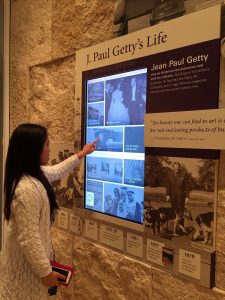
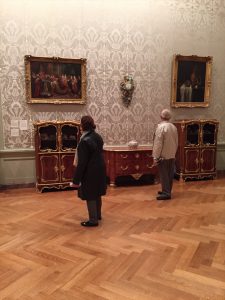
I had not been to the Getty since I was in the third grade, so I had no idea what to expect from this trip. Olivia and I decided to go visit the museum on a cloudy Sunday afternoon, and there were a surprisingly large amount of people who had thought to do the same. When we first walked out of the tram and into the first building, we could not see any sign of technology being used in an exhibition context. So we decided to ask the information center for help, and they were very knowledgeable about the few types of interactive technological pieces the museum held. Of the many exhibitions available at the time, the J. Paul Getty: Life and Legacy exhibition caught our attention in the way that it incorporated such pieces.
The moment we entered through the doors and into the J. Paul Getty: Life and Legacy exhibition, we were immediately greeted with 4 giant digital touch screens. Each were surrounded by a brief wall text description and relayed important facets of J. Paul Getty’s life and his proclivity to collect artifacts. Furthermore, they were organized in chronological order, making it easier for visitors to follow his bibliography. The touch screens themselves contained a plethora of information, including compilations of pictures and videos to compliment each description. From observing visitor interaction with this technology, I found that most were initially very fascinated by and attracted to the novelty of the high-quality touch screens. I also found myself being immediately drawn to one and pressing rapidly at the different options it presented.
However, I came to realize that most of the visitors drew away from these touch screens as quickly as they had initially been drawn to them. In many cases, visitors would step up in front of the touch screen, tap on and read a few sections, scroll through some pictures, and be on their way within a minute or two. One possible explanation for this could be that the visitors were simply disinterested in the specifics of the particular topics that these touch screens presented and more intrigued by his physical collection of artifacts, which was introduced in the next room. Since the touchscreens were accommodated by a wall text that laid out a brief summary of the topic, visitors may have found that to be sufficient information to understand the context of the Getty collection. Another possibility is that visitors might have been hyperaware of one another and their own time on the touchscreens. While the touchscreen interactive pieces were designed for individual use, the wall text was viewed communally. Since there were only four interactive pieces amidst a bustling crowd of people, individuals may have felt uncomfortable lingering in front of these pieces as others waiting their turn. Based on these suppositions, I would draw the conclusion that these touch screens are a useful complement to the wall text and artifacts in the exhibition, but they do not provide a sufficient museum experience by themselves.