I’m currently working at the UCLA Hammer museum, so I’ve had a lot of time to observe and reflect on technologies within the current exhibitions there. There’s the obvious- Simon Denny’s show consists of a bunch of shiny, seamless objects that were fabricated via mass-manufacture processes; slick, printed board games, backlit texts, objects lit and shot with the highest standards of product photography, and a video about the cryptographic blockchain that would fit nicely in a sci-fi film. However, these are examples of technology-as-content. They mostly have to do with what the exhibition is about, not the way that visitors interact with it; a visitor would look at the objects like any other, reflect on the didactic texts, etc etc.
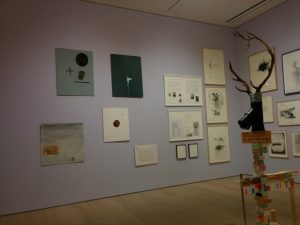
The Jimmie Durham exhibition, where I’d spent most of my time, looks much more low-tech, mostly consisting of found objects assembled together into strange pastiches of industrial objects and nature; levers and chairs mixed with found wood and paint. There were various flat works, too, and one of the ways that they were installed was an enormous two-wall corner, covered with various sketches, collages, and paintings.
In order for a viewer to identify the individual pieces, there was a laminated card which gave information for each of them.
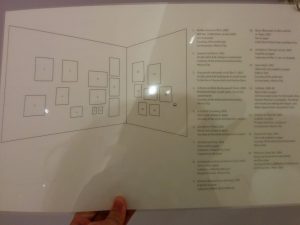
Visitors, however, mostly chose not to make use of the cards. Some glanced at them momentarily, but most simply chose to circle around the installation and focus in on individual pieces that caught their attention. Few even bothered to remove the cards from the wall.
I’m not entirely sure if this counts as a technology, but I did begin to reflect on the way that standards for hanging artwork have changed over time. White walls and ample lighting/space have been relatively modern conventions, and Durham does away with both of those things. The walls are painted a light purple, and the drawings and paintings are hung in a way reminiscent of older methods for displaying art.

Historically, paintings have been displayed in very cramped settings, with less concern or reverence for the individual objects than tends to be the case now. What Jimmie Durham may have been referencing in his exhibit was the “cabinet of curiosities”, a renaissance system for displaying objects that didn’t enforce delineations between objects of natural history, biology, archaeology, and fine art. These were some of the displays that would later become the basis for the museum.
These collections are also part of the most vicious aspects of the impulse to accrue artifacts and objects- If some of the objects displayed were archaeological or anthropological in nature, they also certainly lacked the ethical and moral boundaries that the fields now have (not that either has entirely cleared its name; anthropologists are still heavily distrusted by communities that have been harmed by them). As an individual associated with the American Indian Movement, Durham is certainly aware of the ways that museums and such “intellectual” pursuits have harmed American Indians.
I always actually love those laminated cards. They’re so simple and easy to engage with — plus there’s something sort of reassuring about having something familiar to hang onto when you’re in a disorienting space. And it’s true, practices for displaying artwork have changed drastically. We absolutely expect the “white cube” as part of our museumgoing experience.
This was a very interesting blog post. I love the connections you made between Jimmie Durham’s exhibit and exhibits in history. I too visited this exhibit and did not notice the relation to the renaissance system. But now that you point it out it seems very obvious. I agree that I did not notice visitors making use of the cards which is a shame.
I think it’s interesting how you mention the display of the objects. In every museum I’ve visited, the exhibits were displayed in the same manner – each object has its own space within a massive blank wall for visitors to stop and take in before moving on to the next piece of artwork. I’ve never been to the Hammer Museum, and seeing the Jimmie Durham exhibit and how it’s arranged in the corner makes me wonder how this changes the way visitors do self-guided tours, if at all. I feel like the closer arrangement of the artwork makes me consider more of why the curator wanted to put specific pieces next/in relation to one another rather than the history or meaning behind a single piece.