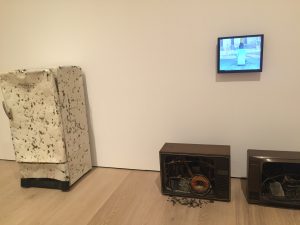
This past weekend, I had the opportunity to visit the Hammer Museum in Westwood for the first time. Although there were several exhibitions that featured technology in various capacities, the one that I chose to focus on was a piece from Jimmie Durham’s “At the Center of the World,” featured in the upper galleries. This exhibit attempts to incorporate North American retrospect through displays that featured predominantly everyday items, adorned with the Durham’s writings. I think it was the contrast of the general flow of the exhibit of very everyday items that made the inclusion of technology stand out.
The piece was entitled “Stoning the Refrigerator” and was a documentation of an accompanying piece called St Frigo, a dented and worn-down antique refrigerator. It was a really interesting compilation of the piece, the standard focus of the display, and the video, which brought in the technological aspect. Initially, I thought that the video was supposed to be an accompaniment to the physical piece, one that was perhaps supposed to provide a backstory to the creation of the piece and give viewers more depth in their engagement with the piece. After observing the art and watching others observe it for themselves, I began to notice that people initially watched the video, and would in most cases, spend more time with the film than with the actual work of art.
To me, watching this interaction was very interesting. Despite the dismantled refrigerator fitting with the flow of the rest of the exhibit, it was the contrasting video that seemed to grab people’s attention. While it could be argued that it was just the sheer difference that made it stand out to people, I think it was an interesting testament to the role that technology plays in museum experiences.
There is a certain level of comfort for the modern day museum goer when it comes to technology. Technology is as commonplace in our lives as anything, arguably even more so than a nuanced piece of art that has a potentially obscure meaning. I believe that technology can help to alleviate some of the pressure or apprehension people may feel when interacting with art that may confound them at the beginning. In some sense, I think the incorporation of technology into an exhibit can help bridge some distance between the viewer and the piece, and bring them more into the experience than previously imagined. Particularly in the case of St. Frigo, we get some clarity on how exactly the artist went about creating the figure we see in front of us. Not only do we follow his process on a surface level, but we get a sense of the emotion that the artist infused into the piece. The aggression, the power, and the patience that went into the repeated motion of throwing a stone at the fridge becomes clear to the viewer. A connection is more easily established when there is a sense of being involved in the creation. While there may be a stereotype of technology being contrasting to art and detracting from the artistry, I believe that this portion of Durham’s exhibit is a demonstration of how technology can bring together viewer, artist, and piece.
I really like your comment about technology in the museum bridging a distance between art and the viewer. It is true that technology can customize and provide more accessibility to viewing art in a museum setting, which is inherently a bit intimidating and confusing. One thing I wonder though, is how museums can measure whether or not their technologies are more distracting than helpful, and what they can do about this issue.
I think this is very insightful. We are drawn to technology that accompanies a work of art because it usually gives us additional information so we feel that it will help us have the “right” understanding of the piece of art we are looking at, especially when it is something obscure. This has definitely happened to me personally so perhaps that is why people spent more time looking at the video than the actual piece of art.