I visit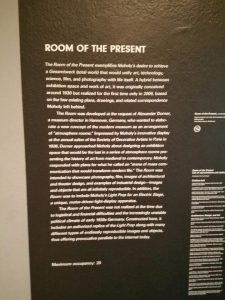 ed the Los Angeles County Museum of Art on Monday and I had hard time finding exhibits that applied a technology but I luckily came across this amazing exhibit called “Room of The Present”, a contemporary fabrication of exhibition space designed by Moholy-Nagy in 1930 which was not realized during his lifetime but recreated later in 2006. The room consists of small film booths, panoramic photography, and industrial design replicas. I personally loved the way things were installed because they were well-harmonized and balanced. Unfortunately, I wasn’t allowed to take photos or touch things, which was a shame because I did not feel like I was having a “real experience” of the room. While observing the exhibit, I overheard a museum guide giving detailed explanation of its background to the visitors, “His structure aimed to integrate isolated phenomena into a coherent whole, space creation is an interweaving of the parts of space, which are anchored in clearly traceable relations extending in all directions as a fluctuating play of forces.” Some visitors asked why the room was full of recreations rather than original pieces of Moholy. “Room of the present,” he spoke, “is an architectural embodiment of Moholy-Nagy’s reason for being. In his obituary, Bauhaus founder Walter Gropius remembered Moholy-Nagy as abundantly versatile and unbiased, always curious to find fresh point of view.”
I noticed that the visitors paid little to no attention to the written texts at the entrance of the room but went straight into the room without any knowledge of it. The revolving sculptures and the film booths are certainly intriguing to see but it seemed like Moholy wanted the visitors to actually learn about the room the way he designed rather than having their own interpretations. The visitors became curious and fascinated with the overall design of the interior, they typically spent about 3-5 minutes in room where most of their attention was caught by the Light Prop which is a kinetic 3-D abstract piece that revolves constantly, its complex design of glass spirals, perforated disks, and wavy metal flags producing incredible visual effects of moving and overlapping colored light and shadow. I also noticed that the visitors had biased attention to the moving objects over the idle ones such as photography, mostly because the room is small and the maximum capacity of the room is limited to 20 people at a time. 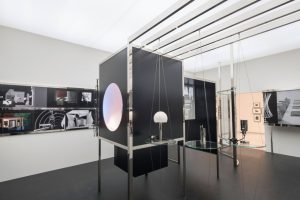
(This is an image from Google because they didn’t allow talking pictures)
As I walked towards the exit, I was little sorry that it ended soquickly. I thought of going in for the second time but lost the urge because the securities were staring at me as if they didn’t want me to. Being in the Room of the Present was quite an experience, but because it was only a recreation, I became curious how it would’ve looked like with the original works of Moholy.
This is so interesting! I love your detailed observations of patrons’ behavior. And I’m also really interested in the dynamic you noticed between the security guards and the patrons.
This exhibit sounds amazing, I would love to check it out! Your observation of the visitors is also so important–it’s very interesting to see that they paid little -to-no attention to the actual descriptive content of the pieces. Perhaps their fascination for the artwork was too distracting for them to fully appreciate the underlying message?
My interpretation of the patron’s behaviour is rooted in our human nature to gravitate towards what attracts our attention the most. I wonder if, without the moving object, that people’s attention would be more evenly distributed around the room.