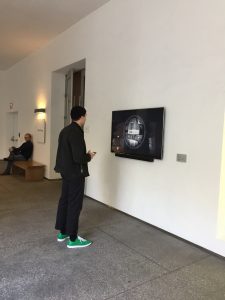
This weekend, Jenny West and I visited the Hammer Museum in Westwood. Like other people in the class, we also spent the majority of our time observing the Simon Denny exhibit on the blockchain. The installation incorporates strategic board games such as Risk in a way to communicate information about the blockchain and its capabilities, especially as a cryptocurrency. The wall outside incorporated a Business Insider article written about Denny about blockchains through backlit windows. The article was printed from the mobile site, which is an indirect example of the incorporation of digital technology. Although there was no interactive technology within the exhibit, outside there was a tv mounted on a wall that played an introduction video about the blockchain on a continuous loop. For a little over 20 minutes, Jenny and I posted ourselves outside on the architecturally unique chairs and observed museum goers who went to Denny’s exhibit.
The observations that we made were not that surprising, considering that people’s actions and reactions were very similar to how I would have interacted with the tv introduction. Many people would quickly glance at the tv before entering the exhibit, and some people briefly looked over at the Business Insider article. There were a couple of groups who actually stood directly in front of the television and watched the video, but because the video plays on a loop its easy to come in during the middle and be confused by what’s happening.

Some of the other observations that we made were that people typically interact more with physical objects using their phones. Families, couples, and other groups would take pictures with sculptures and other art pieces that they found interesting with their phones. Additionally, the chairs outside in the courtyard were extremely popular with both young and old, as people would sit and roll around in the chairs while simultaneously taking photos or video with their phones. The interactive physical objects definitely held people’s attention for a longer period of time than the video did.

I can’t wait to go down and check the Denny piece out! It’s so interesting, the phenomenon you notice of people sort of noticing the video and just walking on by. It supports a line of discussion that we’ve developed in class from time to time: that people see (art) museums as places for objects, not technology.
Your observations seem very on point with what I had observed as well. It seems like things that people can really engage with such as the chairs seemed to hold peoples attention for much longer than videos. I also found that people didn’t take the time to really read the descriptions placed before them.
It is an interesting point of view to list phones as one of the technologies represented in the modern day museum. Even though it is not part of the actual exhibits, they are a staple of the digital age, where everything is recorded and logged. Also, I liked how you talked about the lighting used by the exhibit. People often forget that lighting is a critical part of the tech used in the modern day museum.
Great post! I think that it was interesting you felt that people didn’t fully watch the video, because I thought that was one of the most compelling parts of the exhibit and gave a lot of necessary context to understand the actual pieces inside. That being said, I think that speaks to an interesting perspective on the use of technology and how it can be almost polarizing. As we face so much media in our daily lives, if something requires an extra bit of effort (i.e. waiting for the loop to restart so that you could understand the video), we tend to completely ignore it, purely because we’ve been trained to prioritize our media consumption. This contrast creates an interesting dynamic of technology and art and shows how one must be very strategic in their use of it so that it doesn’t do the opposite of its intent, which is to engage.