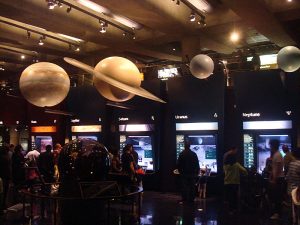
For this blog post, I went to the Griffith Observatory. Although I had been there before, I never observed others interacting with exhibits. When you first enter people spend time briefly looking at the pendulum swinging back and forth. From there most disperse in different directions. The planetarium is a great use of technology as it uses a star projector (which looks like a massive round meteor) to show brief videos about history of space exploration in an incredible visualization inside a dome. For the most part the museum has exhibits on the wall that you can stop and look at. For instance, they have many screens depicting images of planets and a brief text description next to an image explaining its significance. Other areas of the observatory has rooms concerning with various topics like moon phases, tides, eclipses, seasons, elements, etc. They have interactive screens with buttons that can be pressed for learning about specifics regarding a certain topic. They also have a live view of the sun on a screen which shows the sun at its current state via feed from a telescope. People generally don’t stop for too long in most of these areas, however I saw some kids spending significant amount of time just playing with the buttons to see the changes on the screen.
There are also images of planets’ surfaces that people stop and stare at for a few seconds before walking away. On their way to the lower level, you walk along side a wall which is called “the cosmic connection” with jewelry and pictures depicting the evolution of the cosmic from the Big Bang to early life and a picture of Neil Armstrong’s footprint on moon. I feel that most people spend more time in the lower level. I observed a lot of people spending the most time with the weight scales they have showing your weight on different planets. It is one of the most interesting technological uses as it shows your weight on the surfaces of other planets. For instance, Mars has weaker gravity which results in us weighing less there. A lot of kids hop on these scales and spend a lot of time here. This is incredibly cool because humanity will probably have a base on Mars by the end of this century and some of these kids may actually have the opportunity to be on Mars. It is very cool to see how lighter we are on Mars which gave me hope that since you’re able to jump higher maybe I could dunk on Mars . 🙂
I think the topics displayed at the Griffith Observatory lend itself to better uses of technology! I love the interactive nature of the exhibit and how it gets the visitors engaged with the material while learning about our solar system. It’s important to get kids excited about going to museums and giving them a space to explore the content on their own. Thanks for writing about it but most importantly visiting it!
I never thought of the Griffith Observatory as a museum, but you’re totally right, it is! For some reason, whenever I go, it’s so packed, I can barely get to the exhibits. But the technology there can hardly compete with the view!
Since the Griffith Observatory deals in the topic of the solar system, it makes sense the it is more interactive than displays of cultural artifacts from the past. Interactive screens can be utilized better with more undiscovered topics like the universe as opposed to well researched and delicate cultural displays. An interactive digital Saturn exploration seems to work and flow better than a 3D rendering of something like a viking sword or another cultural artifact. Also, I had no idea Griffith did these exhibits, next time I’m there I’ll have to go see them.
I liked how you were thinking outside the box and visited Griffith Observatory. The site definitely offers more technological exhibits which you can have interactions with than most of the museums out there. Plus, the exhibits in the observatory sound very engaging! I might be one of those children playing with the buttons if I ever visit here again.