I’d like to begin this post by stating a fact: Jurassic Park is the greatest movie of all time.

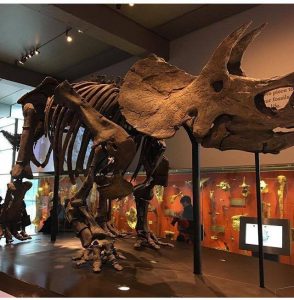
In keeping with this statement, I visited the Los Angeles Natural History Museum this weekend and spent time in the Hall of Dinosaurs (see glorious picture of Dinosaurs).
While the overwhelming majority of the exhibit is physical, there is a digital component on one side of the hall. This display features an assortment of bones and others fossils. These are not fully articulated specimens and represent different portions of a variety of different species. You can also interact “closely” with the digital rendering of the physical item and manipulate it. The display is a large touchscreen device which allows users to type in a number or indicate on a digital display which fossil they would like information about.
I engaged with the display for about ten minutes. Occasionally, I would have to “poke around” to try and figure out how to get to the previous screen or the home screen. That said, I still think the device was fairly user friendly. I did find myself referencing the physical object and when I was done with the touchscreen, I doubled back to look at the physical items.
I observed the crowd engage with the display a little over a half of an hour. There was a decent mixture of young children (between five and ten), adults with very young children (toddlers), and some adults (twenty-somethings) who interacted with the digital display but, interestingly enough, never for very long (less than or around 5 minutes). Often, parents would pick an item or let their child pick an item and would read the text aloud to their child. If their child was old enough, the parent would encourage the child to touch the screen and interact with the object. Overall, these parent-child interactions did not seem to last very long, in part perhaps because the children wanted to get closer to the larger, physical exhibit which was close to the display case. Young children interacted with the display but did not read the text. Instead, they focused mainly on manipulating the object or zooming in and out over the item. Adults, like myself, would choose an item, spend some time reading and interacting with the item and then would move on. There was not a very sustained engagement and I did not watch anyone engage with more than what appeared to be three items.
Part of this might be the timing. I went on a weekend, in the middle of the afternoon in what was likely their peak time. I do wonder what it might be like to watch people interact with the display on a weekday. There was a small line forming by the interactive display so people may have felt pressure to interact with one or two objects and then move their party along.
In terms of people spending time with the textual sections of the exhibit, I did hear a lot of parents reading things to their children. Adults, without children, seemed to be much “pickier” about the time they spent reading anything very text heavy. It seem like if something interested a visitor, they might spend some time reading the text but otherwise people spent a lot of time taking photos with the dinosaurs in the background!
Ha! I have this museum practically memorized, because I have a dinosaur-loving four-year-old, and this all rings very true. One thing that never occurred to me before I read your post is that perhaps, in a way, these site visits can be misleading — even though my daughter doesn’t engage super-long with any individual element of the display, she’s back practically EVERY WEEK, and maybe that changes the picture a bit.