I walk from the metro across the Mall, damp with cold, early morning dew. With the front entrance closed for construction, I head down a service ramp to a small entry underground. A guard sits with his morning coffee just inside the doorway. We greet each other as I hold up my badge from around my neck, and I pass through into the dark maze. Dim spotlights provide just enough light from the immensely high ceilings to navigate. Through the clear plastic coverings, a cowboy sits on horseback looking eerie and ghostly. I know I have almost made it to the elevator when I see the life-sized train, the enormous outline visible by the small amount of sunlight that seeps in through the window coverings. I stare at the market scene that is across from the elevator as I wait, and the fake produce reminds me I forgot to eat breakfast.
When I was in my third year of college, I had the opportunity to intern for a semester at the National Museum of American History in Washington D.C. It was a unique time in the museum’s history, as it was undergoing a major renovation, so the doors were closed to the public. As noted in Geoffrey D. Lewis’ encyclopedia article, the Smithsonian Institution was created due a donation by the Englishman James Smithson for knowledge dissemination. Congress decided that a museum was the most fitting format for Smithson’s charge. The National Mall is lined with many of the museums that respond to the legacy set forth by Smithson, and I would argue that the categorization of objects starts on the level of each of these museums. As noted by the website for Smithsonian Institution, it is made up of “19 world-class museums and a zoo–plus 9 research centers.” While some are encyclopedic in nature, others specialize to a particular area.
The National Museum of American History, as one of the Smithsonian Institutions, has the responsibility of addressing the complicated history of the United States. The mission statement for the NMAH begins by stating: “Through incomparable collections, rigorous research, and dynamic public outreach, we explore the infinite richness and complexity of American history. We help people understand the past in order to make sense of the present and shape a more humane future.”
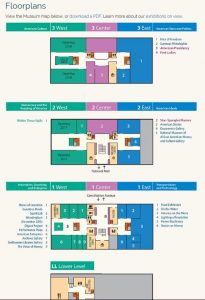
The curatorial staff at the NMAH have taken an interesting approach to this challenge, and the museum has been strongly critiqued over the years, even during the renovation, which I will discuss more later. The current floorplan divides the museum and its four levels into three sections based on directional location: West, Center, and East. The first level has “Innovation, Creativity and Enterprise” in the West wing, “Transportation and Technology” in the East wing, and a reception suite and theater in the Center hall. As I described above, every morning I walked through the iconic “America on the Move” permanent exhibition, which is just one of six exhibitions shown in the East wing on this floor. The others include: “Food Exhibition,” “On the Water,” “Lighting a Revolution,” “Power Machinery,” and “Stories of Money.” I will not recount all of the categories and subcategories of the museum site plan here, as you can read them yourself on the floorplan, but what is important to note is the way that the exhibitions are arrange by broad themes and topics, and maybe they are not what you might expect. The museum does not attempt to arrange itself to tell a history of the country by a timeline of events, as a US history book might, though timelines play a major factor in the subcategories, or exhibitions themselves. The themes come from the staff walking a fine line – on the one hand, showing off the items in the collection that the museum thinks are most critical for the public to see, but also those that most powerfully assist in telling an overall narrative.
Take the exhibition “On the Water,” for example. Maritime stories may seem like an unusual way to approach American History. However, what you may not know is that the NMAH has an enormous collection of maritime artifacts because of a large donation from CIGNA insurance. (The CIGNA firefighting and maritime collection was what I worked on while I was interning. I research their collection of fire paintings.) Utilizing this strength in their collection, the museum narrates a history of the country through the nation’s waterways.
This brings me to one of the benefits and drawbacks of the NMAH. It occupies a catchall position for collecting in this country. While the museum was closed to the public, one exhibition was transferred to another space to continue running on a small scale – “American Stories.” The exhibition is of iconic objects in the museum’s archive. Highlights include Dorothy’s ruby slippers from The Wizard of Oz to President Abe Lincoln’s top hat. The aura of these objects (Benjamin) are so powerful and in tune with the cult of the nation that they are each blockbuster objects on their own. However, the museum has more of these than they could ever display. On one of my early tours of the storage areas with my supervisor, we were roaming through a giant warehouse full of furniture and machinery – items from every aspect of life. As we paused to reorient ourselves before heading out of the giant store room, I looked down at item resting by my feet. I pointed to it and asked, reading off the words painted on the item, “Is that really “The World’s First Margarita Machine?” “Apparently,” my supervisor shrugged in response. He told me that so much is donated, the museum has trouble keeping up with proper collection practices. He regularly fielded emails from people writing to see if their bell bottoms that they found in their mother’s basement were something they should donate, since after all, they are part of an iconic fashion trend. And this was on top of the important work that curators spearhead themselves. My supervisor was the curator who arranged for the Greensboro lunch counter from the famous student “sit” for Civil Rights to be preserved and displayed at the NMAH. I was overwhelmed with tears when he told me that he went to the ground zero sites shortly after 9-11 to collect pieces from the wreckage to be preserved. Those objects are now displayed as the culminating artefacts in one of the museum’s longer exhibits. This is the uncomfortable side of a museum charged with preserving a nation’s history. While I experienced that day as a tragedy, my supervisor had to conjure up a level of objectivity in order to fulfill the mission of the museum and his obligation as an archivist.
Lastly, one of the major criticism of the renovation is that less of the collection would be on display than before the construction started – much less. The museum ends up telling a history through its “highlights,” and while the public is pleased to see these big-ticket items, it often neglects the less popular points of the nation’s history, which are still critical to fulfilling the museum’s mission statement. In addition, just telling a history based on the items in possession limits the kind of narrative you can share.
As an alternative to the highlights approach that the NMAH has taken, I would offer up the Luce Foundation Center for American Art. Located on the top floor of the Smithsonian American Art Museum, the Luce Center is “the first visible art storage and study center in Washington, D.C.” Instead of a narrative being provided, visitors can make their own by “exploring paintings densely hung on screens; sculptures, contemporary craft pieces, and folk art objects arranged on shelves; and portrait miniatures, bronze medals, and jewelry stored in compact drawers.” Information on the works can be found through the computer kiosks located around the open storage area. This method of display allows for more of the collection to be viewed by the public. It also changes the dynamic for learning and adds to the agency of the visitor. You must identify the work you are interested in and then look up the information on the computer system to find out more about it. While it echoes a salon style of display, there is also an intimacy that is gained through the tightness of the rows of viewable storage space. The small interactive element of opening drawers to view medallions reorients the relationship between the object and the visitor. For large collections, I think this is a really effective alternative to a limited display of just the cornerstone objects in a collection.
I found your personal accounts of interning at the museum so fascinating! Your story about your supervisor collecting items after 9/11 for preservation really resonated with me. I think this is definitely a fine line between, as you said noted, fulfilling the mission of the museum to preserve an important and devastating day in American history, and then almost sense of intrusion. On one hand, it is an important collection especially in this century, where people either experienced the day or for those born on the early side of the 2000s, will have a family member who can recount the day, or perhaps lost an immediate family member. For those people, the objects have important memories attached, and it seems necessary to keep those memories alive through materials that are well-preserved. On the other hand, it seems to bring this (much) bigger issue for me personally, about who owns art? Who is allowed to go to a site of destruction and collect objects? Is it only permissible for the most noble causes (ie. The National Museum of American History) as cultural property?