My junior year of high school I took AP Art History with one of my favorite teachers. And this past summer, I was able to visit the National Gallery in London and view in person all of the pieces that I had studied before. I recall getting lost looking for one of the exhibits so it’s only fitting that I look at the visitors map now after I’ve already visited.
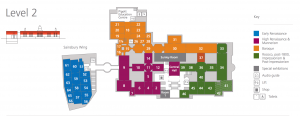
(click on photo for pdf of floor plan)
The map is organized by floor and also split into sections with colors. Although the map goes from Level -2 to Level 2, all of the main exhibitions are on display on Level 2. Level 0 and Level 1 contain the 4 entrances into the museum, which are accessible to the public from Trafalgar Square and Orange Street. Upon entrance to the museum, you have to go upstairs to actually start looking at the exhibits. Each section of the museum is organized by time period and you can work your way chronologically if you begin in the Sainsbury Wing and continue in a clockwise fashion. Each section is further split into smaller rooms, organized by location (country) or artist. The Sainsbury Wing is a separate addition to the museum but is connected by a single hallway, and it houses the Early Renaissance (13th-15th century) paintings. Going clockwise from the Central Hall, the National Gallery has High Renaissance and Mannerism (16th century), Baroque (17th century), and Rococo, Impressionism and Post-Impressionism (18th century). There are some rooms that house special collections such as the current exhibition on Australia’s Impressionists and the next exhibit on Michelangelo and Sebastiano. The museum houses many famous artists and pieces including Vermeer, Monet, Rembrandt, and Leonardo da Vinci.
The museum grew out of a series of gifts of pieces, with the condition that the works would be given suitable accommodation for their display and preservation. Now, the National Gallery is governed by the Museum and Galleries Act of 1992, which lists it as a charitable status. The museum has free admission for 361 days of the year and strives to study and care for the collection as well as provide the widest possible access to the works. In the context of Conn’s article, I don’t think that the museum’s task is solely to “make rational sense of the world” but it may help others make rational sense of Western European art and tradition. The key characteristics of each style period often had reasonings behind them due to both experimentation with painting itself and fitting the trend of the time. The museum houses a national collection of paintings from Western Europe and encourages frequent visitation. During my time in London, I visited the National Gallery more than once and was still in awe each time looking at the works. Because it is free, anyone can visit and oftentimes I saw artists seated with their easel and paints recreating some of the pieces in their own painting style.
An alternate system of categorization could be to display the pieces based on country rather than style period. In this way, visitors’ experiences would be completely different because they would focus on one location at a time and be able to really see the development of each piece over time in respect to where the piece was made. For landscape pieces there may be recurring themes in the nature of the land since all the pieces would have been painted in the same location.
Yes, the National Gallery is a maze! I guess it can also be a bit overwhelming because of all the pieces in there. I like your alternate system of categorization and thought process behind it. I think it allows for better analysis over time but maybe not so much on the geo-political differences/ styles. Interesting to think about! Thanks for sharing.
I liked your idea of grouping items based upon country of origin. It would be cool to sequence them chronologically at that point to offer insight into how different movements in art were interpreted in different cultures – EX – impressionism in Holland. The current exhibit structure allows one to compare EX: impressionism in Holland v impressionism in France, but it might not display the flow between impressionism and post-impressionism in a certain area as well; and understanding how different cultures interpreted and manifested these ideas can offer a lot of insight into the process. I very much like the idea of a gallery of landscapes reflecting different interpretations of the same location.