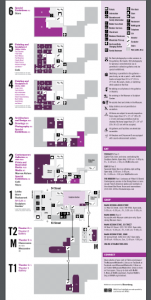
Since I spent so much time looking at the Museum of Modern Art, New York and their acquisitions last quarter I decided to look at their map for visitors. The building helps break the museum up into different categories since the museum has nine floors. The bottom three floors are just theaters and classrooms and the first floor includes the lobby and sculpture garden. The second to sixth floors include the major galleries such as the Contemporary Galleries (1980s-Now), Prints and Illustrated Books, Media, Special Exhibitions, Architecture and Design, Drawings, Photography, Paintings and Sculptures II (1940s-1980s), and Paintings and Sculptures I (1880s-1940s). There are also a few stores and cafes on various floors of the museum. The only subcategories are included in the Paintings and Sculptures I and II which lists the artists features on those floors such as Jasper Johns, Yayoi Kusama, Andy Worhol, Paul Cézanne, Frida Kahlo, and Pablo Picasso to name a few.
Based on the way the museum categorizes its objects of scrutiny, I would say that the museum views its mission as presenting modern art that falls into the medium categories above with most of the emphasis on painting and sculpture. However based on the subcategories I would also say that the museum views its mission as primarily focusing on “Western” art and artists. The permanent exhibitions seem to include mostly art from artists of European or American descent while lacking art from artists of Asian, Middle Eastern, and African descent. That being said, the museum might compensate for that by including more diverse art and artists in their special exhibits but one cannot discern that from just looking at the visitor map.
As a result, an alternate system of categorization would be to organize the floors based on regions around the world. For example, one floor could focus just on Asian modern art and each room could feature exhibits from countries within that region. Within that the museum could choose to also organize different exhibits based on time period and medium but the main method of organization would be based on region. This would demonstrate a much more global outlook since the focus would be on different regions instead of different mediums and time periods. However, this could still bring up issues in regards to what countries and regions should be featured. For example, if the museum chose to focus on the asian countries of China and Japan but ignore countries like Thailand and Cambodia, they would be presenting more of a “first world” world view.
I also went to the Museum of Modern Art in New York this past winter and agree that the map doesn’t highlight artists from diverse cultures in their overall map. I do believe that the way the museum’s many floors are organized by painting/sculpture/drawings etc. is efficient just because the building is so big and there are so many physical objects to display, but your idea of separating by regions around the world would be beneficial to the educational experience of visitors.
After taking a look at the museum and it’s extensive layout with 9 floors, I agree with you that it may be a good idea to categorize the floor based on regions of the world. It would help organize the museum in a way that makes it easier for those interested in a particular region of the world to locate all the artifacts pertaining to that region.