I have never realized how ingrained museums are into our culture until this class. However, I have also never been as critical towards museums until this class as well. Geoffrey D. Lewis writes that museums might have started from a “springing from what may be the innate human desire to collect and interpret…in large collections built up by individuals and groups before the modern era.” The art museums I have typically been to have a system set into place that categorizes art by country/continent/region of origin. While they may categorize the art by time periods, they tend to keep different countries separated from one another. However, I saw a slightly different set into place at the Harvard Art Museums.
The Harvard Art Museums is a building with three museums (Fogg Museum, Busch-Reisinger Museum, Arthur M. Slacker). The top art collection consists of Egypt Art, Greek Art, Roman Art, and Classical Sculpture.

The second level contains Asian art with multiple subcategories such as “East Asian Decorative Arts” and “South Asia in the Medieval and Early Modern Eras”, African art with subcategories such as “The Art of Assemblage” , European Art, as well as art movements such as Impressionism.
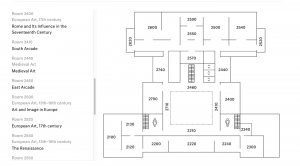
The bottom level is categorized by mainly art movements such as Surrealism, Early Modernism, and Secessionism.
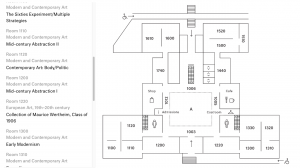
Although the museum was not that large compared to others, I thought they had a good amount of variety in the art collections they had.
I liked how the museum decided to categorize the second first levels by art movements/styles. I can see why it would be effective to categorize art distinctly by origin as it this display can show the vast array of art forms in the world as to display the uniqueness of the worlds cultures. But I also think it is important, as done at this museum, to recognize the cohesiveness that art brings across the world. Also, it is important to include arts from different origins on each level as having them on separate levels strips away the ability to effectively compare and contrast the varying art forms.
I believe it is important to consider time and context when viewing art pieces. If I were to create an alternate sense of categorization I would arrange the artworks from oldest on bottom level to newest on top level. I think seeing how art changes over time by first seeing the older works leaves a powerful impact on viewers as they can see first-hand the evolution of art.
I also agree that context is important in museums, especially if a visitor isn’t very familiar with a particular type of art, an artist, or culture. I do, also the notion of a museum organized chronologically (rather than by origin/continent in distinct floors or wings), for comparison and a sense of human universality.