In Dillenburg’s “What, if Anything is a Museum” article, he defines a museum as “an institution whose core function includes the presentation of public exhibits for the public good”. By this definition, the Huntington Library in San Marino, California counts as a museum. Meanwhile, Conn writes that museums must “devote themselves to collecting, organizing, and displaying particular categories of knowledge”. So how does the way the Huntington Library categorizes its art collections and botanical gardens reflect its educational mission?

Well, first, how does the Huntington categorize its exhibits? It categorizes its art collections not by specific time periods, or even art movement/ genres, but by the location of origin. The Huntington separates its collection into a European Art building, and an American art building. The European art is further classified in subcategories of country, like British, French, Flemish and Italian. The gardens are also mostly categorized by location (either by nation or by habitat), for example, the Japanese, Australian, Chinese, Desert, Subtropical, and Jungle Gardens. However, there are also the Rose, Herb, and Palm Gardens which don’t quite fit the previously mentioned classifications. But in general, the way this museum “collects, organizes, and displays particular categories of knowledge” is according to physical location or origin- either nationality or type of biome.

By grouping its collections in this way, the Huntington Library’s mission is directed towards cultivating an understanding of different cultures and places. It’s saying that British art and culture is different from French art and culture, and that Japanese gardens and culture are different from Chinese gardens and culture. This type of classification promotes an awareness of the uniqueness of each nation’s traditions.
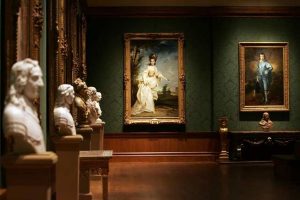
An alternate classification for the art exhibits could be to classify by art movements and genres, as many other museums do. This would alter the museum’s mission by emphasizing the international influences and reasons behind each artistic movement, as opposed to a nation’s individual timeline of art. An alternate classification for gardens could be to categorize by plant type (ex: types of trees, types of flowers,etc) – the Huntington does do that for the Rose, Herb, and Palm Gardens- but that really would not make sense for the Japanese, Chinese, Jungle Gardens, etc. First, the for national gardens, the viewer would not get an authentic, cultural experience. For example, it would mix up traditional types of plants that were put together with the Chinese ponds, bridges, waterfalls, and architecture. The focus would be shifted to the significance of botany, instead of a cultural experience. Second, it wouldn’t make sense to categorize the biome-based gardens by type of plant, because then the focus would be on the science of individual plant species, rather than the whole animal and plant communities that live in that habitat. In this case, the focus would be more on botany, instead of ecology.