In the reading ‘material/materiality’, Hong emphasises that material is defined by the physicality of the material itself, and that it takes a tangible form. Hong also suggests that despite the physical nature of material, it can be elaborated and can assume potential based on its association with non-physical matter. Hegel refers to the word ‘materie’, which includes both the physical form of material and also the ‘mind’ or ‘spirit’ and to the ‘abstract or ideal’, taking the meaning higher than surface level. This involvement of higher meaning opens the doorway to the world of fine arts and associating meaning not only with the physical aesthetic but also the meaning behind it. Hong then discusses the word ‘materiality’, defined as ‘that which constitutes the ‘matter’ of something. In other words, not the form itself but the quality of being material.
In the Conn reading, he suggests that the basic component of museums is the object (or objects) in the museum. He claims that nowadays objects are disappearing from museums and in their place are audiovisual and other technological replacements. He says that traditional museums collected and organised their content in ‘scientific’ ways of categorisation, but today the distinctions are much more fluid. Today, museums have fewer objects and are less visual, causing us to have a higher expectation of each object to tell a complex story that was once told by many objects.
Spending time in the Special Collections library gave me awesome insight into the world that Johnson was living in. Contrary to the Conn reading, there is an incredible amount of content in the form of objects that can be put on display from Johnson’s work. One piece that particularly stood out to me was a newspaper clipping from Los Angeles, 1923 (see attachment)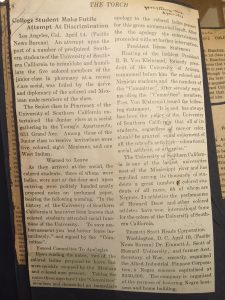 . It reports on racist and discriminatory statements made by students at USC during a social gathering. Not to say that USC students are racist today, but it reminded me of the moral and intellectual superiority we have here at UCLA.
First, shoutout to UCLA for being morally and intellectually superior. I really enjoyed the breadth of information from the reading that you included and I agree that the materials we are working with there is a lot of content to dissect, but I would’ve loved to see you include more of your direct response to the text based upon your overall experience in the Special Collections.
I agree with your stance that the physical objects still have incredible merit in the depth through which they can share information and important historical context. While there I believe that museums are more successful when they can employ the use of objects in a way that does construct a broader narrative and history, there most definitely, as seen in Johnson’s collection, a wealth of information that can be found just from reading the articles and examining the words he preserved.