Objects and Identity: Challenges Facing Museums and Collections in the Digital Age
Museums today are struggling to balance their timeless objects and the movements and demands of the modern age. Cultural institutions face increasing challenges which threaten their identity and, perhaps, their very existence. American museums are particularly vulnerable since they must answer to many sources for their funding, mission focus, public programs and exhibitions. Some of their issues can be traced to their historical roots and their rapid evolution in the cultural landscape of a young country.
Charles Willson Peale was one of the original masterminds of the American museum and conceived it to be a didactic preservation center. Serving and educating the public through philanthropic means was the mission for many early American museums, which were often started by the country’s greatest Robber Barons. However, American culture took a major turn in the 1890’s as large cities began to form and industrialize, creating a blossoming of social centers. Chicago’s World’s Fair, held in 1893, was an example of where America began to blur the lines between culture and entertainment. The event allowed for the juxtaposition of Beaux-Arts architecture and the largest Ferris wheel. The fair had a profound effect on the arts, architecture, Chicago’s self-image and American industrial optimism. In addition, the World Columbian Exposition poked holes in many previous notions of exhibition spaces and objects, which up to that time had been seen as being permanent and serious. New technology was allowing art to be temporary. Out of hundreds of buildings erected, only a few remained standing after the fair. It was also one of the first places where the power of the commercial public could really be felt, grossing millions upon millions of visitors and their hard-earned dollars. Today, the importance of the public and their wants can no longer be overlooked in the museum.
As new trends and technologies continue to arise, from destination architecture to a more collaborative work process, museums are finding it difficult to maintain roots and sprout wings. When the oldest museums in the United States were started about 200 years ago, they were intended to be a tool for the American people. Now, centuries later, it is unclear whether their old missions can survive with the museum’s new goals. In his chapter “Do Museums Still Need Objects?” Steven Conn provides a historical overview that traces the adaptation and renovation of museums over the years, and it is clear that museums have needed more than a makeover; they need to solve an identity crisis.
Carol Duncan and Alan Wallach argue in their essay The Universal Survey Museum that, “The museum’s primary function is ideological,” and that it is meant to express, “Society’s most revered beliefs and values” (1980: 448-469). However, it is undeniable that practical matters plague the modern museum. With a more integrated and diverse society, museums cannot simply do as Charles Willson Peale did in the 1780s and merely act as, “America’s educator, presenting the exhibition of natural and human history as a means of perfecting individuals and society” (Ward, 2004: Preface; Conn 35, 41). They have to do more. Museum today, particularly those in the United States, which do not survive off of government funding as in most European countries, but rather off the dime of corporate sponsors, private donors, and public attendance, are finding that in order to maintain operations they must attend to the needs of many for support. Conn identifies this distinct shift through the work of Stephan F. de Borhegyi on the Milwaukee Public Museum where an extensive exhibition survey was conducted in order to better tailor and catering the exhibitions to visitors’ wants.
Curators have had to make significant adjustments. As Nancy Villa Bryk, curator of domestic life at the Henry Ford Museum & Greenfield Village, wrote in an article for Museum News, “Until the early 1980s, curators created products based on a notion of what [they] thought [their] visitors wanted to see” (2001). However, she admits, “Exhibits largely reflected our personal interests and appealed to the rather small group of visitors and each other as if we were connoisseurs who had to prove we had a handle on the collection” (ibid). When her museum acquired a new president, Harold K. Skramstad, Jr., he wanted his curators to change the way they worked. Curators, not only at the Henry Ford Museum & Greenfield Village, but across the U.S. began focusing on the “so what” of their exhibitions and how their subject matter pertained to their audience. In addition, curators were forced to become more collaborative in their process. In order to make their exhibition truly successful on all levels, it became obvious that all components, from the design department to the museum education staff, had to come together to produce a complete and compelling story. Well-curated collections and exhibitions are what draw most visitors to the museum.
First Look at the George P. Johnson Collection
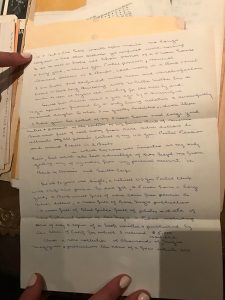
We stare for a few more moments, soaking it in. “Looking may be called enchanted,” Stephen Greenblatt explains, “when the act of attention draws a circle around itself from which everything but the object is excluded, when intensity of regard blocks out all circumambient images, stills all murmuring voices” (Greenblatt 1991, 49). The three of us take a moment to awaken from our reverie after being wonderstruck by the folder full of handwritten notes from the George P. Johnson collection before we continue on with time in the Young Research Library Special Collections.
Tucked behind a glass door and through another wooden one to a small dim room lined with old books from floor to ceiling, the special collections class room generated an experience through “boutique lighting” that Greenblatt argues can, “provoke or heighten the experience of wonder” (Greenblatt 1991, 49). He suggests that this tactic is utilized based on this lighting’s close association with commerce and that it is effective because wonder is closely knit to the notions of acquisition and possession (Greenblatt 1991, 49). As we turned the pages of the documents in the folder, we attempted to decipher as much as we could of the handwritten notes and lists, which also reflects Greenblatts line of thought that, “if there is a string initial appeal to wonder, a wonder that then leads to the desire for resonance,” the impact of the experience with the objects is enhanced (Greenblatt 1991, 54). We identify and feel encourage to participate and engage with what we are seeing.
Pulled from their specially ordered and numbered archive boxes, the George P. Johnson collection become imbued with a level of importance that handwritten notes and old newspapers clipping are not normally provided. The quotidian becomes a static, frozen ritual object separated from its intended use within a performance. The ceremonial-like process of that is embedded in any trip to special collections reminds me that curatorial discretion often has prerogatives that are not always apparent to viewers (Roberts 1994, 49-54). As we carefully turned the fragile pages contained in the archive folder, we were not thinking about the smell of the old books, the dim lighting, the wooden cabinets and furniture that is generating an aura of reverence and formality (Hong 2003). Different from an assessment of the formal composition of the material object itself (Wölfflin), we are struck by uniqueness of the objects we encounter (Benjamin) and how through one man’s collecting and preservation efforts, we have a window into the history of race films in the United States that could have easily have been lost, like the rest of the Lincoln Company films that were destroyed in a storage fire (ibid). While reading the transcripts from the interviews with George P. Johnson provided a fascinating oral history, looking at the documents directly conveys the passion and pressure Johnson felt to preserve the legacy and history of race films in the United States in a way that could only be understood through physical demonstration. The attention to detail and painstaking care that went into his collection provides a different kind of insight.
Understanding Fragmented Objects
Barbara Kirshenblatt-Gimblett argues in “Objects of Ethnography” that:
Objects are ethnographic not because they were found in Hungarian peasant household, Kwakiutl village, or Rajasthani market rather than in Buckingham Palace or Michelangelo’s studio, but by virtue of the manner in which they have been detached, for disciplines make their objects and in the process make themselves.” (Kirchenblatt-Gimblett 1991, 387)
While George P. Johnson was born in Colorado, the material that fills his collection comes from a myriad of places across the United States and were gathered over a lifetime. In the archive folders, things from magazines are juxtaposed with personal notes and records. Date, place, and price take on new meanings. The mundane objects have taken on a new life in special collections. Like many objects that end up in museums, these materials were previously utilized in many different and practical ways by someone else. In the institution, we have placed a value on them which differs from that which they held in their previous life (Roberts 1994, 48).



Beautifully written! It’s difficult to grapple with the complexities and material realities (and intense limitations) of museums. I really appreciate the way you discuss funding here. Often, when we discuss the ideological pursuits of museums and the collections, there isn’t enough emphasis (ironically, perhaps) on how the infrastructure of the museum sustains itself. Thank you for citing the Kirshenblatt-Gimblet piece, as well. I have not read that but that quote is stellar! Excited to read it and look into it!
I agree that museums have goals that are often more ideological, and that in order to accomplish their goals, they have had to shift their perspectives on how they appeal to visitors. However, I feel like the content fundamentally skirted around the topics of materiality and the role of objects in museums, as presented by the reading. This did not really serve as much of a reflection on those items, and seemed to be addressing more general matters, related to the title of the course itself. I would have liked to see more commentary on the reading topics and less quotes from extraneous texts.