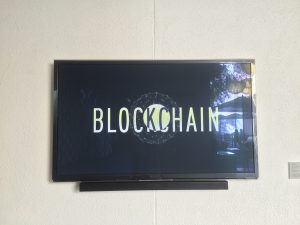
I visited the Hammer Museum, and looked at a project by Simon Denny. The Hammer as a whole incorporates minimal technology its in exhibitions- Denny’s was the only one that featured any digital element. Right outside the door to the exhibition was a TV screen, playing a looping, black-and-white video that described something called the “blockchain”. The first words in the video are, “Imagine a world where trust is guaranteed, a world without borders, a world in which each and every one of us takes part in the whole. This world is already here, embedded in the blockchain, waiting for its emergence”. The Hammer pamphlet on Simon Denny describes a blockchain as “a protocol for an online database that can record and execute contracts, financial transactions, property ownership transfers, elections, and much more…[it is] the underlying structure of the cryptocurrency Bitcoin…[and] has the potential to revolutionize any transaction that would otherwise require third-party oversight”. All of the visitors I saw the began watching the video stayed until the end- probably because it was an interesting idea, yet confusing and difficult to grasp- a very different topic than I’ve ever seen covered by a museum before.
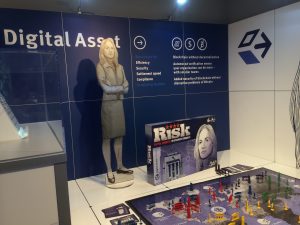



Inside the actual exhibit, there was no use of technology- the viewer was left to figure out the thought-provoking art without a digital narrator guiding them along the way. The project featured three different outcomes for the future banking and technology industry based on the blockchain, represented by custom versions of the board game, Risk. The presentation was very interesting- it felt like I was at a convention and seeing new products that were being introduced to the market. The pamphlet describes Denny’s work as “blurring the lines between art and promotional material”, and this exhibit as “based on the typical tech fair trade booth”. Honestly, I was quite confused while looking at the whole exhibition, and the video that explained what a blockchain was was especially helpful in grasping what the basic idea behind the meaning of the art was. I saw one woman actually watch the video after going inside to look at the exhibit, and I can imagine if I did that I would have been utterly lost while looking inside. I found myself trying to read much of the wall text, in order to figure out what the display was depicting, and almost wishing that there was some sort of technology inside to help me understand. One of the wall texts inside described that Denny had “taken on the task of mediating the look, meaning, and implications of possible new world orders”. It was definitely a very unique museum experience- almost not feeling like a museum at all.
I think in this instance of museum technology, it was very useful in giving the visitor some background knowledge and context before entering the exhibit. Since the project topic was more modern, and even futuristic, the use of technology did not feel out of place. Visitors seemed to be drawn to the video explaining blockchains, because it was confusing, and the video helped to understand the core of Denny’s message. There was almost no interaction with the technology- since it was a video and not an interactive iPad activity or anything. I think, perhaps, the Hammer purposefully crafts an atmosphere that limits a visitors use of technology as a means to engage with the art on display.